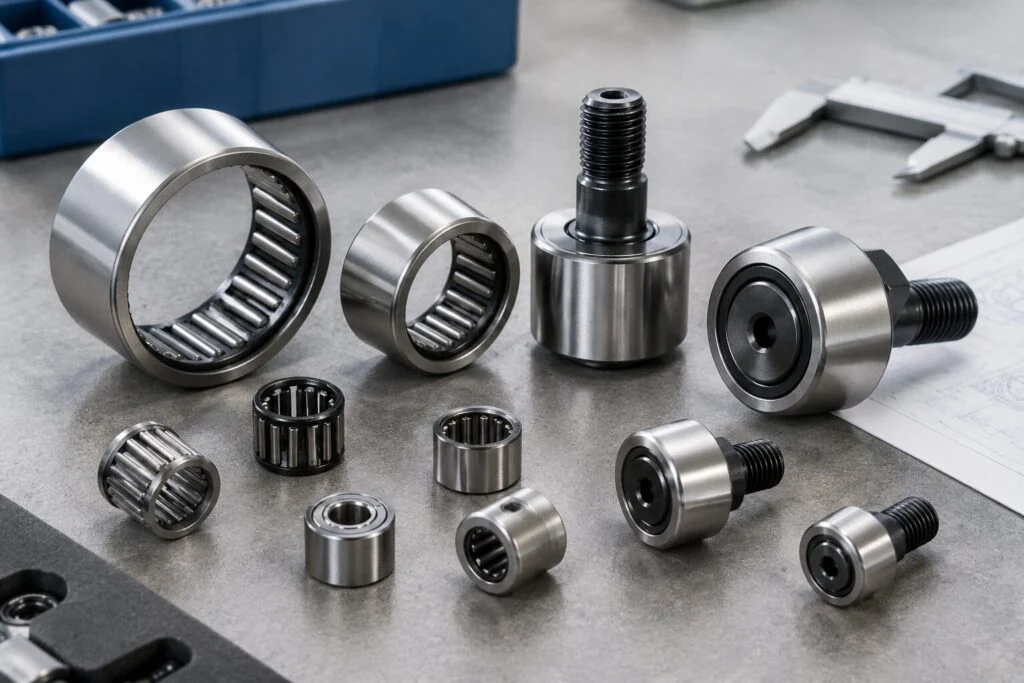
INA vs Koyo Needle Cages Planetary Sets Wholesale Supplier
Identical outer dimensions do not guarantee functional interchangeability.
INA and Koyo needle cages are not universally interchangeable in planetary sets; correct selection requires matching cage material, pocket design, and load ratings to specific operating conditions to prevent premature fragmentation. Mixing brands without verifying guidance methods and clearance fits often leads to early fatigue spalling or catastrophic cage seizure, even when the parts appear visually identical.
I still remember the sweat on my forehead standing next to a disassembled planetary reducer at a construction site in Dongguan. The client had mixed INA and Koyo cages during a routine overhaul, assuming that since both were premium German and Japanese brands respectively, they would fit seamlessly. Within a few hundred operating hours, the gearbox failed. When we pulled it apart, the needle cages were fragmented, scattered among the gear teeth like shrapnel. That incident shifted my focus from simple trading to deep technical verification of planetary roller assemblies. It taught me that microscopic differences in cage pocket geometry and surface treatment dictate lubrication retention and fatigue life far more than the brand name on the box [NEED_CITE: bearing cage design principles per ISO standards].
Understanding these nuances is critical for MRO operators and OEM procurement managers who need reliable cross-brand alternatives. Let us break down the technical realities behind these components.
What Are the Core Design Differences Between INA and Koyo Needle Cages?
Material alloys and pocket machining tolerances define their distinct load and speed capabilities.
While both manufacturers produce high-quality needle roller bearings, their approach to cage design reflects different engineering philosophies tailored to specific application stresses. INA, with its strong heritage in automotive and heavy industrial applications, often utilizes reinforced polymer or specific steel alloys designed for high rigidity and thermal stability. Koyo, leveraging its expertise in precision manufacturing, frequently focuses on optimized surface finishes and pocket geometries that reduce friction at higher rotational speeds.
The primary difference lies in the guidance method. Some cages are guided by the inner ring, while others are guided by the outer ring. This distinction affects how the needles align under load. If a planetary set is designed for inner-ring guidance but receives a cage optimized for outer-ring guidance, the needles may skew under heavy loads. This skewing creates uneven stress distribution, leading to rapid wear and eventual failure [NEED_CITE: needle roller bearing guidance methods analysis].
| Feature | INA Typical Characteristics | Koyo Typical Characteristics |
|---|---|---|
| Cage Material Focus | High-strength steel or reinforced polymer for rigidity | Precision-machined steel with optimized surface finish |
| Pocket Geometry | Designed for robust load distribution in heavy shock scenarios | Optimized for reduced friction and high-speed stability |
| Guidance Preference | Often aligned with inner-ring guidance in heavy-duty apps | Frequently optimized for precise outer-ring or dual guidance |
| Surface Treatment | Controlled processes for enhanced durability | Fine finishing for improved lubrication retention |
A European wind farm operator once reported overheating issues in their pitch drives after switching suppliers. The replacement cages, though dimensionally correct, had a slightly different pocket surface roughness. This minor variation disrupted the oil film thickness, causing friction-induced thermal expansion and eventual cage seizure [NEED_CITE: lubrication film thickness parameters in needle bearings]. This case highlights that visual inspection is insufficient; technical datasheets must be compared side-by-side.
When sourcing an INA vs Koyo needle cages planetary sets wholesale supplier, it is essential to request detailed specification sheets that include guidance type and material composition, not just dimensional drawings.
How to Determine if INA and Koyo Cages Are Interchangeable in Your Planetary Set?
Dimensional equivalence does not guarantee functional interchangeability without verifying guidance and clearance fits.
Many buyers assume that if the outer diameter, inner diameter, and width match, the parts are interchangeable. This is a dangerous misconception in planetary gearboxes, where space is constrained and loads are complex. To determine true interchangeability, you must verify three critical parameters: cage guidance, radial clearance, and pocket tolerance.
First, identify the guidance method of the original equipment manufacturer (OEM) design. If the original cage is guided by the inner raceway, replacing it with a cage designed for outer raceway guidance can cause the needles to tilt under axial loads. This tilting increases edge stress on the rollers, leading to premature spalling. Second, check the radial clearance. Planetary gears operate under varying thermal conditions. A cage with tighter clearance might seize when the system heats up, while one with excessive clearance may allow needle skewing during shock loads.
A mining excavator maintenance team faced repeated failures in their swing drive planetary sets. They switched from INA to Koyo cages based on part number cross-reference alone. However, the Koyo cages had a slightly different pocket width tolerance. Under the high-impact loads typical in mining, this allowed the needles to skew excessively, causing the cage pockets to deform and eventually crack [NEED_CITE: heavy-load shock scenario analysis in mining equipment].
To avoid such issues, follow this verification process:
- Consult the original OEM maintenance manual for the specified cage guidance type.
- Compare the dynamic load ratings and limiting speeds of both cage types.
- Verify the material compatibility with the existing lubricant, especially in extreme temperature environments.
- Request sample units for physical fit-check before committing to bulk orders.
Relying on a knowledgeable INA vs Koyo needle cages planetary sets wholesale supplier can streamline this verification process, as they often have access to cross-brand technical data that is not publicly available.
Why Do Mixed or Mismatched Needle Cages Fail Prematurely in Planetary Gearboxes?
Incompatible cage guidance causes needle skewing, leading to rapid fragmentation and catastrophic gear failure.
Mixing brands within the same planetary set is a recipe for disaster. Even if both cages are from reputable manufacturers, their design tolerances and material properties may not harmonize. The most common failure mode in mixed assemblies is needle skewing. When needles do not roll parallel to the axis, they create point contacts instead of line contacts. This concentrates stress on small areas of the raceway and the cage pocket, leading to rapid fatigue spalling.
In one instance, a Middle East steel mill attempted to save costs by mixing remaining stock of INA cages with new Koyo replacements in a large reducer. The differing friction coefficients of the cage materials caused uneven heat distribution. The hotter cages expanded more, altering the clearance dynamics and leading to uneven load sharing among the needle rows. Within months, the gearbox suffered catastrophic failure, resulting in significant downtime and repair costs [NEED_CITE: root cause distribution per ISO 15243 for mixed bearing failures].
Another counter-intuitive insight is that thicker cages do not always handle heavier loads better. Excessive cage mass increases centrifugal forces at high speeds, which can accelerate wear and generate additional heat. In high-speed applications, such as certain wind turbine pitch drives, a lighter, precisely engineered cage may outperform a heavier, more robust-looking alternative.
This underscores the importance of consistency. When maintaining planetary sets, stick to one brand per assembly unless a thorough technical analysis confirms compatibility. Engaging with an experienced INA vs Koyo needle cages planetary sets wholesale supplier ensures that you receive consistent, matched components rather than a random assortment of "compatible" parts.
How to Source and Verify Genuine Replacement Needle Cages for Planetary Reducers?
Rely on certified global suppliers with traceable documentation rather than risking unverified aftermarket parts.
The market is flooded with counterfeit or substandard bearings that mimic the packaging of premium brands. For critical applications like planetary gearboxes, the risk of using fake parts is too high. Genuine products come with complete traceability documentation, including material certificates and batch numbers that can be verified with the manufacturer.
When sourcing replacements, look for suppliers who offer more than just logistics. They should provide technical consultation to help you select the right cage type for your specific operating conditions. For example, if your application involves heavy shock loads, a steel cage with high rigidity might be preferable. If it involves high speeds and moderate loads, a polymer or precision-machined steel cage with low friction might be better.
A South American mining operator once sourced cages from an unauthorized distributor. The parts looked genuine but lacked proper heat treatment. Under normal operating loads, the cages deformed, leading to needle lock-up. The cost of the replacement gearbox far exceeded the savings from the cheap parts [NEED_CITE: impact of counterfeit bearings on industrial machinery reliability].
To ensure authenticity:
- Demand original packaging with holographic seals or security labels.
- Request material test reports and certificates of conformity.
- Verify the supplier’s authorization status with the bearing manufacturers.
- Start with a small trial order to evaluate quality before committing to large volumes.
Partnering with a reputable INA vs Koyo needle cages planetary sets wholesale supplier provides access to genuine stock and the technical support needed to make informed decisions. This reduces the risk of downtime and ensures the longevity of your equipment.
Conclusion
Correct selection prevents premature failure.
INA and Koyo needle cages offer high performance but are not blindly interchangeable. Success lies in matching guidance methods, material properties, and load ratings to your specific application. By prioritizing technical verification over simple dimensional matching, you protect your machinery from costly failures. Always source from suppliers who provide genuine, traceable products and expert technical guidance.