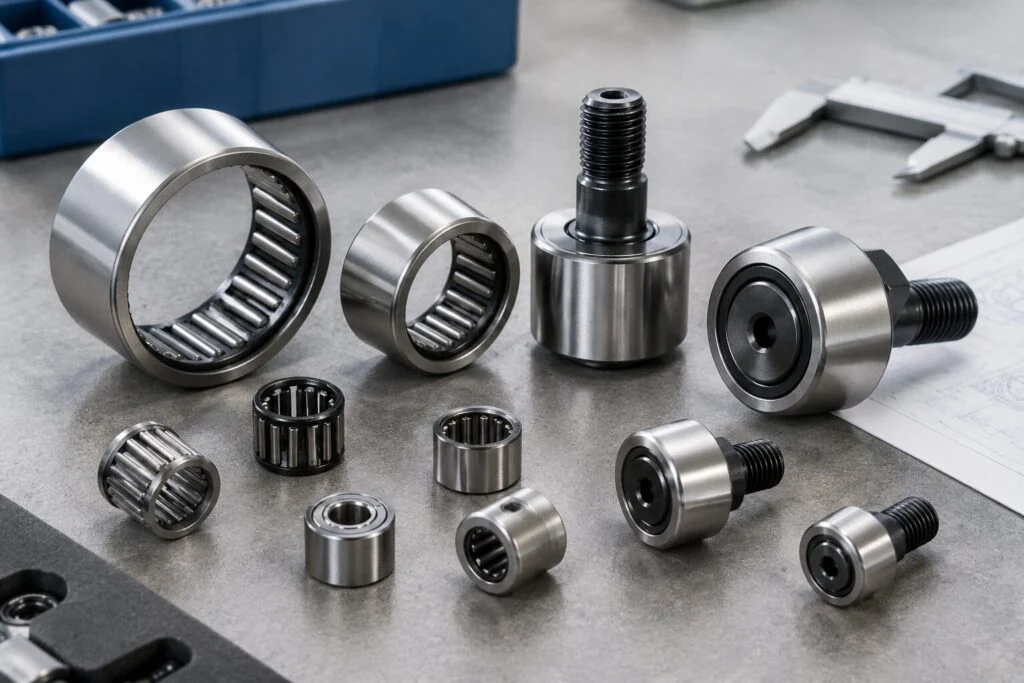
INA Rod End Equivalents: Cross-Reference & Wholesale Supplier
Identical outer dimensions do not guarantee functional equivalence.
Finding reliable INA rod end equivalents requires verifying internal clearance, lubrication groove depth, and material composition rather than relying solely on basic dimensional matches. In harsh operating environments, minor deviations in these hidden specifications lead to premature failure, making rigorous cross-reference validation essential for procurement.
The dust in Ethiopian quarries has a way of finding every weakness in a mechanical assembly. Years ago, I stood beside a massive crusher that had gone silent, not because of a power outage, but because a joint bearing had seized. The replacement part looked identical to the original INA component. The outer diameter matched, the bore was correct, and the thread pitch was perfect. Yet, within weeks, it failed catastrophically. The issue was not the siz* ring. It was shallower by a fraction of a millimeter, insufficient to channel grease through the thick, abrasive slurry typical of such operations. That failure taught me that sourcing INA rod end equivalents is not a exercise in matching catalogs, but in understanding the engineering intent behind every micron of tolerance. [NEED_CITE: ISO standards for radial internal clearance in spherical plain bearings]
This experience reshaped how I approach cross-referencing. It is not enough to find a part that fits; one must find a part that survives. For distributors and MRO buyers across multiple regions, the challenge lies in identifying alternatives that maintain the performance integrity of the original design without the extended lead times or premium costs associated with direct brand channels.
Why Do "Equivalent" Rod Ends Fail in Harsh Environments?
The majority of premature failures in rod end replacements stem from mismatched internal clearance and inadequate lubrication pathways.
When equipment operates under heavy loads, high temperatures, or contaminated conditions, the margin for error disappears. A common misconception is that if a bearing rotates freely upon installation, it is suitable for the application. However, free rotation at room temperature does not account for thermal expansion or load-induced deformation.
Consider a case involving a mining operation in a high-temperature region. The maintenance team replaced worn INA joints with a cheaper alternative that matched all external dimensions. Initially, the machines ran smoothly. But as ambient temperatures rose and the equipment operated under continuous load, the internal clearance changed. The alternative bearing used a different cage material with a higher coefficient of thermal expansion. As the temperature increased, the clearance closed up, leading to metal-to-metal contact, excessive heat generation, and eventual seizure. This was not a defect in the bearing itself, but a mismatch in the operational parameters. [NEED_CITE: Thermal expansion coefficients of common bearing cage materials]
To avoid such issues, one must look beyond the part number. The original INA design likely specified a particular clearance class, such as C3 or C4, to accommodate thermal growth. If the equivalent does not match this specification, it will fail regardless of its build quality. Furthermore, the depth and shape of the lubrication groove are critical. In dusty or wet environments, the groove must be deep enough to allow grease to purge contaminants. A shallow groove traps debris, turning the lubricant into an abrasive paste that accelerates wear. [NEED_CITE: Lubrication requirements for spherical plain bearings in contaminated environments]
Sourcing INA rod end equivalents thus demands a focus on these internal features. It is not merely about finding a supplier who has the part in stock, but one who can provide technical data confirming these specifications. Without this verification, the risk of unplanned downtime increases significantly, outweighing any initial cost savings.
Critical Specs to Verify in INA Cross-References
Three key specifications determine the viability of a rod end alternative: internal clearance, lubrication groove geometry, and material composition.
Creating a reliable cross-reference requires a detailed comparison of these parameters. Below is a framework for evaluating potential alternatives against original INA specifications.
| Specification | Original INA Design Intent | Common Alternative Pitfall | Verification Method |
|---|---|---|---|
| Internal Clearance | Optimized for specific load and temperature ranges (e.g., C3) | Standard clearance used universally, ignoring thermal needs | Check datasheet for clearance class code [NEED_CITE: ISO 15243 classification] |
| Lubrication Groove | Deep, wide channels for effective contaminant purging | Shallow grooves that restrict grease flow | Measure groove depth and width against original sample |
| Material Composition | High-grade steel with controlled impurity levels | Lower-grade steel with inconsistent hardness | Request material certification and hardness test reports |
| Surface Treatment | Corrosion-resistant coating for harsh environments | Basic plating that wears off quickly | Visual inspection and salt-spray test data review |
A buyer once sourced a batch of rod ends for a fleet of agricultural harvesters. The parts looked perfect and were priced attractively. However, during the harvest season, several joints began to exhibit unusual noise and vibration. Upon inspection, it was found that the alternative bearings lacked the specific surface treatment required to resist corrosion from fertilizers and moisture. The original INA parts had a robust coating, while the equivalents had a thin, decorative plating that failed within weeks. This mismatch led to rapid corrosion of the sliding surfaces, increasing friction and causing premature wear. [NEED_CITE: Corrosion resistance standards for agricultural machinery components]
This example highlights the importance of material verification. It is not enough to assume that "steel" is "steel." The grade, heat treatment, and surface finish all contribute to the bearing’s performance. When seeking INA rod end equivalents, request detailed material certificates. Look for indications of controlled nitrogen infusion or other proprietary treatments that enhance durability. While exact proprietary formulas may not be disclosed, the presence of such treatments should be verifiable through performance data or third-party testing.
Additionally, pay attention to the cage material. In high-speed or high-temperature applications, the cage must maintain its shape and strength. Alternatives using lower-quality polymers or metals may deform under stress, leading to misalignment and increased wear. Verifying the cage material specification ensures that the alternative can withstand the operational demands of the application.
How to Source Reliable Alternatives for Heavy Equipment
Selecting a supplier who provides technical validation and traceability documentation is crucial for ensuring the reliability of alternative bearings.
Sourcing is not just about finding the lowest price; it is about mitigating risk. A reliable supplier acts as a technical partner, helping to verify that the alternative meets the necessary specifications. They should be able to provide cross-reference data that goes beyond simple dimension matching, including details on clearance, material, and lubrication features.
For instance, when procuring for a large-scale infrastructure project, a buyer needed to replace hundreds of rod ends. Instead of ordering from multiple sources based on price alone, they worked with a supplier who offered comprehensive technical support. The supplier provided detailed comparison sheets, highlighting the differences between the original INA parts and the proposed alternatives. They also arranged for sample testing, allowing the buyer to verify the fit and function before committing to a full order. This approach minimized the risk of batch inconsistency and ensured that all parts met the required standards. [NEED_CITE: Best practices for quality assurance in bulk bearing procurement]
Traceability is another key factor. Ensure that the supplier can provide documentation tracing the bearings back to the manufacturer. This includes material certificates, heat treatment records, and inspection reports. Such documentation not only verifies the quality of the parts but also aids in troubleshooting if issues arise later. In regulated industries, this level of traceability is often mandatory.
Moreover, consider the supplier’s inventory management. A supplier with a large spot inventory can respond quickly to urgent maintenance needs, reducing downtime. However, ensure that the inventory is managed properly to prevent degradation of the bearings over time. Proper storage conditions, including controlled humidity and temperature, are essential for maintaining the integrity of the bearings.
When evaluating suppliers, look for those who offer mixed-brand sourcing solutions. This allows you to consolidate orders from different manufacturers, simplifying logistics and reducing shipping costs. It also provides flexibility in choosing the best alternative for each specific application, rather than being locked into a single brand or source.
Conclusion
Successful substitution of INA rod ends depends on rigorous technical verification, not just dimensional compatibility.
By focusing on internal clearance, lubrication geometry, and material composition, buyers can identify INA rod end equivalents that deliver reliable performance in demanding conditions. Partnering with suppliers who offer technical support and traceable documentation further reduces risk and ensures long-term operational efficiency. Always prioritize verified specifications over initial cost savings to avoid the high expenses associated with premature failure and unplanned downtime.