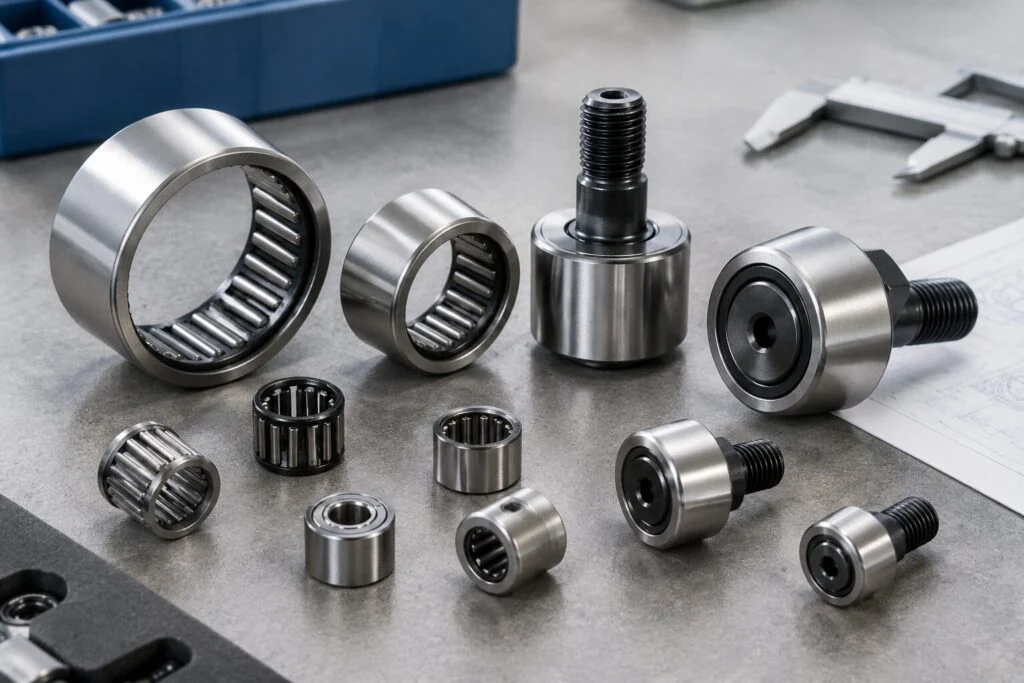
INA Bearing Range Overview: Wholesale Supplier for Bulk & MRO Orders
Assuming identical series numbers guarantee interchangeability is a costly error that leads to premature failure.
Selecting the correct INA bearings requires precise matching of internal clearance and load ratings to specific operating conditions, rather than relying solely on brand reputation or series similarity. A comprehensive INA product range overview must include cross-brand alternatives and rigorous model verification to prevent customs delays and operational downtime in MRO scenarios.
I still recall the silence on the other end of the phone when a client in Dubai realized their container of needle roller bearings was stuck at port. The issue was not the quality of the goods, but a mismatch between the declared customs description and the actual MRO replacement part numbers inside. The discrepancy triggered a manual inspection, leading to weeks of demurrage charges that far exceeded the value of the cargo itself. This incident highlighted a critical gap in global supply chains: technical accuracy is just as vital as logistical speed. [NEED_CITE: common causes of customs clearance delays for industrial components]
Understanding the nuances of INA bearings goes beyond reading a catalog. It involves recognizing where these components fit within the broader landscape of industrial maintenance and how to source them efficiently without falling into common procurement traps.
How to Select Right INA Bearing for Specific Loads?
Load capacity and speed limits are not interchangeable metrics; misjudging either leads to rapid degradation.
When evaluating the INA product range, engineers and procurement specialists must distinguish between dynamic and static load requirements. Needle roller bearings, a cornerstone of the INA lineup, offer high radial load capacity in a minimal cross-section. However, this advantage comes with sensitivity to misalignment and edge loading. [NEED_CITE: ISO standards for rolling bearing load ratings]
Consider a case involving a textile machinery manufacturer in Southeast Asia. They initially specified standard cylindrical rollers for a high-speed loom spindle. The space constraints were tight, and the initial choice seemed logical based on diameter alone. However, the oscillating motion of the loom created conditions where needle roller bearings would have provided superior performance due to their higher line contact ratio. The switch reduced heat generation and extended maintenance intervals significantly.
| Load Characteristic | Needle Roller Bearings | Cylindrical Roller Bearings | Deep Groove Ball Bearings |
|---|---|---|---|
| Radial Load Capacity | High | Very High | Moderate |
| Axial Load Capacity | Low/None | Low/None | Moderate |
| Space Efficiency | Excellent | Good | Good |
| Misalignment Tolerance | Low | Moderate | High |
| Speed Capability | High | High | Very High |
This comparison illustrates why a one-size-fits-all approach fails. For applications requiring compact design with heavy radial loads, such as gearbox pinions or pump shafts, the INA needle roller bearings alternative options must be evaluated against strict spatial and load criteria. Simply swapping brands without verifying the internal geometry can result in early fatigue failure. [NEED_CITE: bearing failure modes related to misalignment]
The key is to map the operational profile—load direction, magnitude, and speed—against the specific design features of the bearing type. This ensures that the selected component from the INA product range aligns with the mechanical demands of the application.
Cross-Brand Alternatives: INA vs SKF/FAG/NSK
Brand loyalty should not override technical equivalence and supply chain resilience.
In the MRO sector, availability often dictates choice. While INA bearings are renowned for their precision in needle and thrust applications, situations arise where lead times or budget constraints necessitate looking at alternatives. Brands like SKF, FAG, NSK, and NTN offer comparable products, but direct substitution requires careful validation.
A European automotive supplier once faced a production halt due to a shortage of specific INA cam followers. Instead of waiting for restock, they explored equivalents from other major manufacturers. The challenge was not just dimensional compatibility but also material hardness and cage design. By consulting a detailed cross-reference matrix, they identified a suitable alternative that met the ISO tolerance classes required for their assembly line. [NEED_CITE: ISO tolerance classes for rolling bearings]
| Feature | INA | SKF | FAG | NSK |
|---|---|---|---|---|
| Primary Strength | Needle & Thruster | General Purpose & Seals | Precision & Industrial | Automotive & Electric |
| Cage Material Options | Steel/Polymer | Steel/Brass/Polymer | Steel/Brass | Steel/Polymer |
| Global Availability | High | Very High | High | High |
| Customization Level | High | High | High | Moderate |
It is crucial to note that while dimensions may match per ISO standards, internal clearances (C2, C3, C4) and lubrication types can vary between brands. An INA needle roller bearings alternative must be checked for these subtle differences. For instance, a bearing designed for high-temperature environments may use a specific polymer cage that is not standard in all equivalent models from other brands.
Sourcing from a reliable INA MRO supplier who understands these nuances allows for flexible substitution without compromising performance. This approach builds resilience into the supply chain, ensuring that maintenance schedules are not dictated by single-source bottlenecks.
Avoiding Customs & MRO Sourcing Pitfalls
Documentation accuracy is as critical as product quality in international trade.
The earlier mention of the Dubai shipment delay is not an isolated incident. In many regions, particularly the Middle East and Africa, customs authorities scrutinize industrial imports closely. Discrepancies between the commercial invoice, packing list, and the physical goods can lead to severe penalties.
For INA bearings, the issue often lies in the description. "Bearing" is too generic. "Needle roller bearing, part number XYZ, for automotive use" is precise. When sourcing through an INA MRO supplier, ensure that the documentation reflects the exact technical specifications and intended use. This clarity helps in classification and reduces the risk of inspection delays. [NEED_CITE: best practices for industrial import documentation]
A mining operator in South America experienced significant downtime because a batch of replacement bearings was held up due to vague labeling. The parts were genuine, but the lack of detailed part numbers on the outer packaging caused suspicion. Resolving the issue required additional verification steps, costing time and money.
To avoid such pitfalls:
- Verify part numbers against the manufacturer’s catalog before ordering.
- Ensure the commercial invoice lists full technical descriptions, including type and series.
- Request certificates of origin and material test reports if required by local regulations.
- Work with suppliers who provide consistent packaging and labeling standards.
These steps are essential for maintaining smooth operations. An experienced INA MRO supplier will anticipate these requirements and provide the necessary documentation proactively, ensuring that goods clear customs without unnecessary hurdles.
Strategic Sourcing for Long-Term Reliability
Consistency in supply and technical support defines a true partnership.
Beyond the immediate transaction, the value of a supplier lies in their ability to support long-term operational goals. This includes providing access to the full INA product range, offering technical advice on selection, and managing inventory for critical spares.
For regional distributors, having a partner who can consolidate mixed-brand orders simplifies logistics. Instead of managing multiple relationships for SKF, FAG, and INA products, a single source can streamline procurement. This is particularly beneficial for MRO clients who need small batches of various types quickly.
The focus should be on building a relationship where technical queries are answered accurately and swiftly. Whether it is clarifying the difference between two similar INA bearings or finding a hard-to-find obsolete part, the supplier’s expertise becomes an extension of the buyer’s team.
By prioritizing technical accuracy and documentation integrity, buyers can mitigate risks and ensure that their maintenance operations run smoothly. The right INA MRO supplier acts as a strategic ally, helping navigate the complexities of global sourcing while delivering genuine, high-quality components.
Conclusion
Precision in selection and documentation prevents costly operational disruptions.
Navigating the INA product range effectively requires more than just identifying part numbers; it demands an understanding of load dynamics, cross-brand equivalencies, and regulatory compliance. By focusing on technical accuracy and partnering with knowledgeable suppliers, businesses can secure reliable access to INA bearings and maintain optimal equipment performance. This approach transforms procurement from a transactional task into a strategic advantage, ensuring longevity and efficiency in industrial operations.