INA vs HIWIN Linear Guides: Wholesale Supplier for Bulk Orders
Brand loyalty is a liability when structural mechanics dictate failure.
Choosing between INA and HIWIN linear guides requires matching the rolling element structure—roller versus ball—to the specific load profile and precision requirements of your machinery, rather than selecting based on brand prestige or initial unit cost alone.
I learned this lesson the hard way during a procurement cycle for a high-speed packaging line retrofit. Under pressure to reduce capital expenditure, I authorized a full swap from specified INA roller guides to HIWIN ball guides, assuming the dimensional compatibility was sufficient. The machines ran smoothly for the first few months, but as production loads increased, we noticed a gradual degradation in positioning accuracy. By the sixth month, the repeatability had dropped to unacceptable levels, forcing an emergency shutdown. The downtime costs far exceeded the initial savings from the component swap. This experience shifted my focus from simple part replacement to structural analysis. [NEED_CITE: fundamental differences between roller and ball bearing kinematics under moment loads]
Understanding these mechanical distinctions is critical for any wholesale supplier for bulk orders dealing with industrial OEMs or MRO operators. The decision is not about which brand is superior, but which architecture aligns with your application’s physical demands.
What Are the Core Structural Differences Between INA and HIWIN?
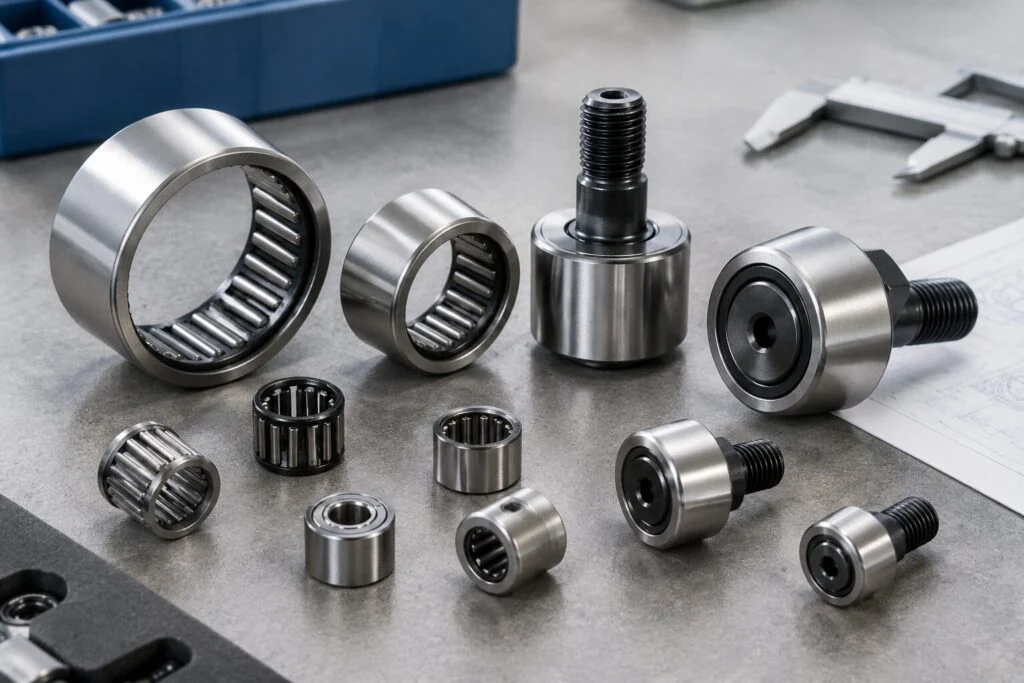
The primary distinction lies in the rolling elements and their contact geometry. INA, a German engineering brand, has long specialized in needle roller and cylindrical roller technologies. Their linear guides often utilize a roller arrangement that provides line contact rather than point contact. This design distributes load over a larger surface area, resulting in higher rigidity and better resistance to moment loads. [NEED_CITE: ISO standards for linear motion bearing load ratings]
HIWIN, a leading manufacturer from Taiwan, dominates the market with high-precision ball screw and ball guide technologies. Their standard linear guides use recirculating ball bearings, which offer point contact. This configuration generates significantly less friction, allowing for higher speeds and smoother motion at lower costs. While HIWIN does produce roller guides, their core competency and volume strength remain in ball-based systems.
| Feature | INA Roller Guides | HIWIN Ball Guides |
|---|---|---|
| Rolling Element | Cylindrical Rollers | Recirculating Balls |
| Contact Type | Line Contact | Point Contact |
| Rigidity | Very High | Moderate to High |
| Friction Coefficient | Higher | Lower |
| Ideal Load Profile | Heavy, Moment, Shock | High Speed, Standard Radial |
| Precision Stability | Excellent under heavy load | Excellent under light/medium load |
A European automation integrator once faced vibration issues in a gantry system. They were using standard ball guides for a cantilevered arm that experienced significant overhung moments. Switching to a roller-based solution eliminated the micro-slippage that was causing the vibration. [NEED_CITE: effect of preload class on linear guide rigidity and vibration damping]
For a wholesale supplier for bulk orders, recognizing this structural divide is essential. Recommending a ball guide for a heavy-duty stamping press application will lead to premature failure, while specifying a roller guide for a high-speed pick-and-place robot adds unnecessary cost and friction.
How Do Load, Speed, and Precision Dictate Your Choice?
Selection criteria must be driven by the operational parameters of the end-use equipment. Load capacity is not just about static weight; it involves dynamic forces, acceleration, and moment loads. INA’s roller structures excel in applications where heavy masses are subjected to high acceleration or where the load is not perfectly centered. The line contact prevents the brinelling and deformation that can occur in ball guides under similar stress.
Conversely, speed and efficiency favor HIWIN’s ball guides. In applications such as semiconductor handling or lightweight assembly lines, the low friction of ball bearings reduces heat generation and energy consumption. The precision of modern HIWIN guides is sufficient for the vast majority of general automation tasks. [NEED_CITE: industry benchmarks for linear guide precision classes]
Consider a case from a Southeast Asian electronics manufacturer. They initially specified high-end roller guides for all their conveyor systems. After reviewing the actual load data, we helped them switch to standard HIWIN ball guides for the non-critical sections. The performance remained identical, but the project cost decreased noticeably. However, for their main lithography equipment, they retained the roller guides to ensure zero deflection under thermal expansion stresses.
When advising clients, a wholesale supplier for bulk orders must ask detailed questions about the application environment. Is the load constant or variable? Are there shock loads? What is the required service life? These factors determine whether the robustness of INA or the efficiency of HIWIN is the correct technical fit.
What Are the Hidden Costs of Mismatching Brands?
The most expensive mistake in linear motion procurement is not the price of the component, but the cost of its failure. Mismatching the guide type to the application leads to accelerated wear, loss of precision, and unplanned downtime. For an MRO operator in a steel plant, a failed linear guide can halt an entire production line, costing thousands per hour.
A common misconception is that INA is simply "more expensive" and HIWIN is "budget-friendly." In reality, using an INA roller guide in a light-load, high-speed application is over-engineering. You pay for rigidity you do not need, and the higher friction may require more powerful motors. Conversely, using a HIWIN ball guide in a heavy-moment application leads to frequent replacements. The total cost of ownership includes maintenance labor, spare parts inventory, and production losses.
| Scenario | Consequence of Mismatch | Long-term Impact |
|---|---|---|
| Ball Guide in Heavy Moment Load | Premature wear, play development | Frequent replacement, accuracy loss |
| Roller Guide in High-Speed Light Load | Excessive friction, heat buildup | Higher energy costs, motor strain |
| Incorrect Preload Selection | Stiffness mismatch, vibration | Reduced component life, noise |
A Middle East cement plant operator experienced repeated failures in their kiln charging system. They were using standard ball guides that could not handle the dust ingress and heavy shock loads. Switching to a sealed, heavy-duty roller guide system extended the maintenance cycle substantially. [NEED_CITE: impact of sealing and lubrication on linear guide life in harsh environments]
For a wholesale supplier for bulk orders, providing technical consultation is a value-added service that prevents these costly errors. Understanding the application context allows for recommendations that optimize both performance and budget.
How to Procure and Verify Authentic Linear Guides?
Procuring genuine components is critical, especially in markets flooded with counterfeits. Authenticity ensures that the material quality, heat treatment, and precision grinding meet the manufacturer’s specifications. Counterfeit guides often use inferior steel and lack proper hardness, leading to rapid failure under load.
Verification starts with traceability. Reputable suppliers provide batch numbers and original packaging with security features. Check the surface finish and marking clarity. Genuine INA and HIWIN products have precise, laser-etched markings. Inspect the rolling elements for uniformity and smoothness. Any roughness or inconsistency indicates poor manufacturing quality.
Technical datasheets are another verification tool. Compare the supplied product’s dimensions and tolerances with the official manufacturer’s catalog. Discrepancies in mounting hole positions or rail width can indicate a non-genuine part. [NEED_CITE: guidelines for identifying counterfeit industrial bearings and linear guides]
A distributor in Latin America once received a shipment of guides that looked identical to the genuine article but failed under basic load testing. The internal ball retainer was made of plastic instead of the specified polymer, causing it to melt under friction. This highlights the importance of sourcing from verified channels.
For a wholesale supplier for bulk orders, maintaining a transparent supply chain is non-negotiable. Offering cross-brand technical consultation and ensuring genuine inventory helps clients avoid the risks associated with counterfeit components. Building trust through consistency and technical expertise is key to long-term partnerships in the global bearing market.
Conclusion
Selecting the right linear guide is a technical decision, not just a purchasing one.
Matching the structural advantages of INA roller guides or HIWIN ball guides to your specific load and speed requirements prevents premature failure and optimizes total ownership costs. A knowledgeable wholesale supplier for bulk orders provides the technical insight needed to make these critical choices, ensuring reliability and efficiency in your industrial operations.