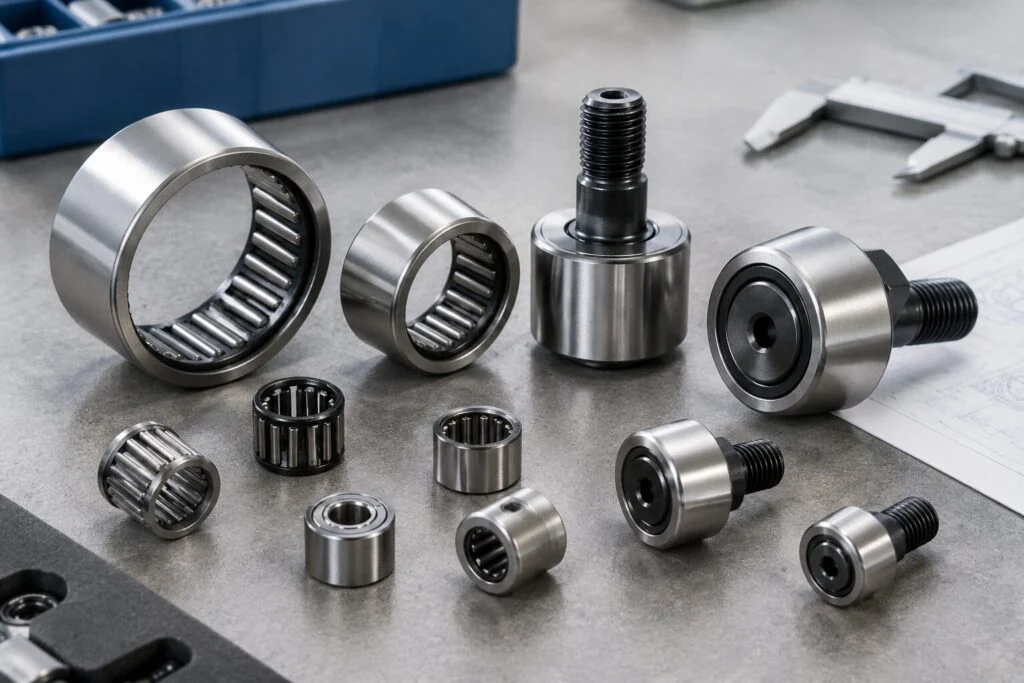
INA vs Hepco Track Roller Systems: Wholesale Supplier
Brand loyalty does not prevent line stoppages.
Selecting between INA and Hepco track rollers relies on matching sealing structures and lead times to specific harsh-environment conditions, not just brand preference. For dusty automotive lines or heavy-load conveyors, the critical decision factor is often the multi-lip sealing effectiveness of INA needle rollers versus the custom profile robustness of Hepco, balanced against global spot inventory availability.
The humid air in Rayong Province carries more than just heat; it carries fine abrasive dust from nearby industrial zones. Years ago, while configuring an automation line for an automotive parts manufacturer in Thailand, I specified a well-known British brand for its reputation in heavy-duty applications. The technical datasheets looked perfect. The load ratings were sufficient. However, the local environment was not a clean room. Within weeks, the track rollers seized. The dust had bypassed the standard seals, grinding the internal raceways into silence. The replacement parts were stuck in a three-month logistics delay. The production line stood still. That silence was expensive. It taught me that in industrial procurement, the "best" brand is irrelevant if it cannot survive the specific contaminants of the site or arrive before the backup stock runs out. Today, when buyers ask me to compare these two giants, I do not start with price. I start with the dust. [NEED_CITE: common failure modes in track roller bearings per ISO 15243]
This perspective shapes how we approach sourcing. As a global supplier dealing with thousands of part numbers, I see the same pattern repeat across Southeast Asia, the Middle East, and Latin America. The choice is rarely about which brand is superior in a vacuum. It is about which system aligns with the operational reality of the factory floor and the urgency of the maintenance schedule.
What are the core design differences between INA and Hepco?
INA excels in sealed needle roller technology, while Hepco focuses on heavy-duty custom profiles and guide wheel systems.
Understanding the architectural DNA of each brand is the first step in avoiding mismatched applications. INA, part of the Schaeffler group, has built its reputation on precision needle roller bearings. Their track rollers are often extensions of their core competency: high-density rolling elements packed into compact spaces with sophisticated sealing arrangements. This makes them particularly effective in applications where space is constrained but load capacity must remain high. The needle design allows for a larger contact area within a smaller envelope, distributing stress more evenly across the raceway. [NEED_CITE: fundamental design principles of needle roller bearings]
HepcoMotion, on the other hand, approaches linear motion from a different angle. Their strength lies in heavy-duty profiled rail systems and guide wheels. These are often larger, more robust units designed for substantial structural loads. They are frequently seen in large-scale automation, material handling, and heavy machinery where the sheer mass of the moving component requires a beefier interface. The design philosophy prioritizes mechanical robustness and modularity over the compact precision of needle arrays.
| Feature | INA Track Rollers | Hepco Guide Wheel Systems |
|---|---|---|
| Core Technology | Needle roller bearing based | Profiled rail and guide wheel based |
| Primary Strength | Compact high-load capacity | Heavy-duty structural support |
| Sealing Focus | Multi-lip integrated seals | Standard industrial seals |
| Typical Application | Precision automation, tight spaces | Heavy material handling, large frames |
| Customization | Standardized high-precision ranges | Highly customizable profile lengths |
A European OEM once faced a dilemma when designing a new assembly cell. They initially leaned toward Hepco for its perceived ruggedness. However, the design team realized the mounting brackets had limited space. Switching to INA allowed them to maintain the required load rating while reducing the footprint of the carriage assembly. The decision was not about quality; it was about geometric compatibility. [NEED_CITE: dimensional constraints in automation cell design]
How do sealing structures perform in high-dust environments?
INA’s multi-lip seals significantly extend lifespan in dusty factories, preventing the premature failure seen with standard industrial seals.
The incident in Thailand was not an anomaly. In many emerging industrial hubs, air filtration is not always sufficient to keep fine particulate matter out of bearing housings. Dust is the enemy of precision motion. Once it enters the raceway, it acts as a lapping compound, destroying the surface finish and leading to rapid fatigue.
INA has invested heavily in sealing technology. Many of their track rollers feature multi-lip contact seals that create a labyrinthine path for contaminants. These seals are designed to retain lubricant while actively excluding external debris. In contrast, many standard heavy-duty track rollers, including some entry-level offerings from various brands, rely on simpler single-lip or gap seals. These are adequate for clean environments but struggle in high-particulate settings.
I recall a case involving a cement plant operator in Vietnam. They were experiencing frequent failures on their conveyor inspection carts. The original equipment used generic heavy-duty rollers. The dust from the clinker processing was infiltrating the bearings every few months. We recommended switching to INA track rollers with enhanced sealing specifications. The result was not immediate magic, but the maintenance interval extended noticeably. The rollers ran substantially longer before requiring regreasing or replacement. [NEED_CITE: effectiveness of multi-lip seals in contaminated environments]
It is crucial to note that no seal is invincible. However, the right seal for the right environment can mean the difference between a quarterly maintenance shutdown and an annual one. Buyers must look beyond the load rating and examine the sealing diagram. If the environment is dusty, wet, or corrosive, the sealing structure is more important than the brand name on the box.
Which brand offers better lead times and spot availability?
INA’s global supply chain often provides faster emergency replacements compared to the longer lead times associated with specialized custom profiles.
Reliability is not just about the product surviving; it is about the product arriving. In the world of MRO (Maintenance, Repair, and Operations), downtime costs money by the minute. A premium bearing that takes three months to ship is less valuable than a good bearing that arrives in three days.
Hepco systems, particularly those involving custom-length rails or specialized guide wheels, often operate on made-to-order lead times. While this ensures a perfect fit for unique applications, it creates vulnerability in emergency situations. If a guide wheel fails on a critical line, waiting for a custom manufacture can halt production for weeks.
INA, benefiting from the massive infrastructure of its parent company, maintains a broader network of standardized stock. Common track roller sizes are often available in regional distribution centers globally. This does not mean every part is always in stock, but the probability of finding a direct replacement quickly is higher for standardized needle roller components.
A buyer in the Middle East once faced a critical breakdown on a packaging line. The failed component was a specialized Hepco guide assembly. The lead time from the manufacturer was eight weeks. We were able to source an equivalent INA track roller system that matched the load and dimensional requirements within days. The modification to the mounting bracket was minimal, but the line was back up in a week. The lesson was clear: single-brand sourcing creates single points of failure in the supply chain. [NEED_CITE: impact of supply chain resilience on manufacturing uptime]
How to select the right track roller for your application?
Prioritize site conditions like dust and load over brand loyalty, and consider mixed-brand sourcing for risk mitigation.
Selection should never be a reflexive choice. It requires a systematic evaluation of the operating environment. Here is a practical approach to making the right decision:
- Assess the Contaminants: Is the environment clean, dusty, wet, or corrosive? If dust is present, prioritize brands with proven multi-lip sealing technologies like INA. If the environment is clean but loads are extreme, consider the structural robustness of Hepco profiles.
- Evaluate Load and Space: Calculate the dynamic and static load requirements. Check the available mounting space. If space is tight, needle roller-based systems (INA) offer higher load density. If space is ample and structural rigidity is key, profiled systems (Hepco) may be preferable.
- Check Lead Times: Consult with suppliers about current stock levels for both brands. Do not assume availability. For critical applications, identify interchangeable alternatives from both brands to create a backup plan.
- Verify Dimensional Interchangeability: In many cases, INA and Hepco components are not directly interchangeable due to different mounting standards. However, understanding the dimensional envelopes allows engineers to design flexibility into the initial layout.
A common mistake is assuming that a premium brand equals best performance in all scenarios. Actually, mismatched sealing for dusty environments causes premature failure regardless of the brand’s prestige. Another counter-intuitive view is that sticking to one brand ensures consistency. Actually, cross-brand alternatives save production when lead times drag.
By keeping genuine INA spot inventory and offering cross-brand technical support, we help clients navigate these trade-offs. The goal is not to sell a specific brand, but to ensure the machine keeps running. Whether it is an INA needle roller for a dusty automotive line or a Hepco profile for a heavy steel mill, the right choice is the one that matches the reality of the factory floor.
Conclusion
The best track roller is the one that stays sealed and arrives on time.
Choosing between INA and Hepco is not about declaring a winner. It is about matching engineering strengths to operational needs. INA offers superior sealing and compact precision, ideal for harsh, space-constrained environments. Hepco provides robust, customizable solutions for heavy structural loads. Smart procurement involves understanding these distinctions and maintaining a flexible supply strategy that prioritizes uptime over brand allegiance.