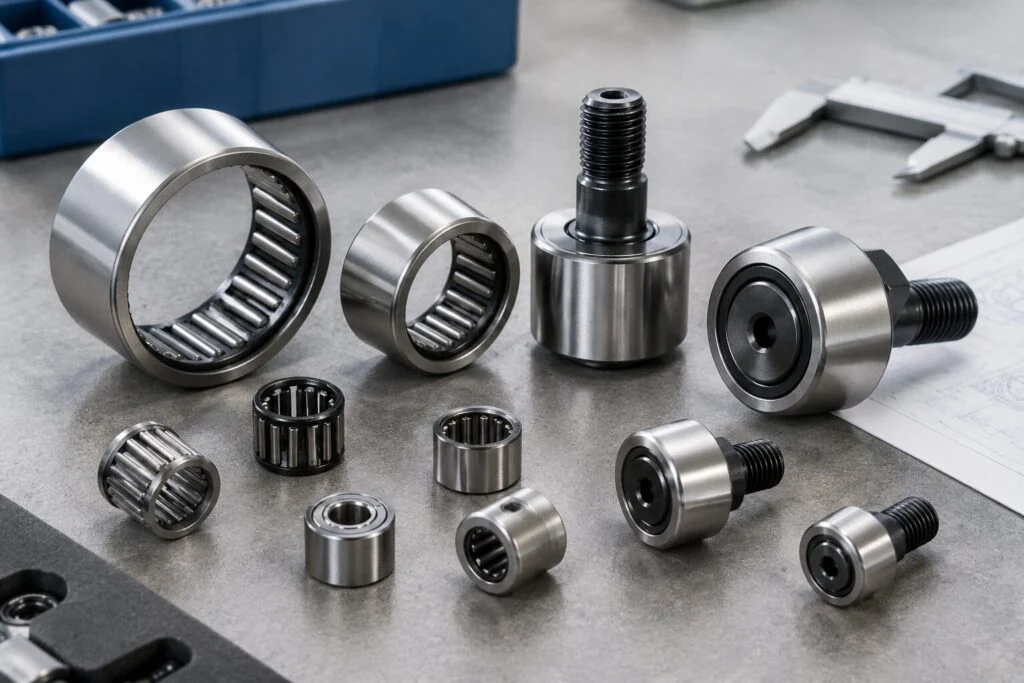
INA vs Durbal Rod Ends: Genuine Wholesale Supplier for Bulk Orders
Interchangeable dimensions do not mean interchangeable performance.
Choosing between INA and Durbal rod ends relies on matching self-lubrication and clearance limits to specific heavy-duty operating conditions, rather than just comparing unit prices. The core argument for selecting one brand over the other is not about the sticker cost, but about preventing premature field failures caused by mismatched internal clearance tolerances and liner friction coefficients under extreme boundary friction.
I learned this the hard way in Chicago. I was working with an agricultural machinery OEM that wanted to cut costs on their new harvester line. We sourced a batch of Durbal rod ends as a direct alternative to the specified INA parts, banking on the dimensional compatibility and the lower unit price. On paper, it was a win. In the field, it was a disaster. Under heavy load, the linkage developed noticeable noise. The self-lubricating liner in the alternative parts could not handle the extreme boundary friction of the high-impact harvesting cycle. The internal clearance expanded rapidly, leading to batch returns and freight claims that wiped out any initial savings. That experience shifted my focus from price-per-unit to lifespan-per-application. [NEED_CITE: impact of internal clearance on rod end service life]
To make the right choice, you must look beyond the catalog dimensions. You need to understand how each brand handles dynamic loads, static loads, and the critical moment when lubrication fails. This guide breaks down the technical differences to help you select the correct component for your heavy-duty application.
What are the core structural differences between INA and Durbal rod ends?
The difference lies in the self-lubricating liner’s performance under extreme boundary friction.
Many buyers assume that if the outer diameter and bore size match, the rod ends are functionally identical. This is a dangerous misconception. The primary structural difference between INA and Durbal rod ends is not the steel housing, but the composition and behavior of the sliding layer. Both brands use high-strength steel for the housing, but their approach to the inner sliding surface varies significantly based on their engineering heritage.
INA, part of the Schaeffler group, often integrates its rod ends into a broader system of precision bearings. Their self-lubricating maintenance-free rod ends typically feature a multilayer sliding layer. This design is engineered to provide consistent low friction even when external lubrication is absent or insufficient. The liner is designed to withstand high specific loads while maintaining a stable coefficient of friction. [NEED_CITE: multilayer sliding layer technology in maintenance-free bearings]
Durbal, with its strong presence in the industrial and automotive sectors, also offers robust self-lubricating solutions. Their rod ends are known for durable polymer-based liners that perform well in standard oscillating movements. However, the material formulation differs. In high-impact scenarios, the response of the liner to micro-deformations can vary. If the liner is too soft, it may extrude under heavy static loads. If it is too hard, it may not embed contaminants effectively, leading to abrasive wear.
| Feature | INA Rod Ends | Durbal Rod Ends |
|---|---|---|
| Sliding Layer Type | Multilayer composite / PTFE-based | Polymer-based / Reinforced plastic |
| Friction Coefficient | Consistently low under boundary lubrication | Low in standard oscillating conditions |
| Contaminant Embedding | High resistance to abrasive particles | Standard resistance depending on liner grade |
| Primary Design Focus | Precision and system integration | Durability in industrial linkages |
When evaluating these components, do not just look at the static load rating. Consider the dynamic environment. Will the joint be subject to constant vibration? Is there a risk of dust ingress? The liner’s ability to handle these factors determines whether the rod end will last for years or fail within months. [NEED_CITE: friction coefficient comparison of self-lubricating bearing materials]
How do INA and Durbal perform under heavy-load and high-impact conditions?
Load capacity means little if clearance stability collapses under impact.
Heavy-duty applications, such as crushers, excavators, and agricultural harvesters, subject rod ends to extreme shock loads. In these environments, the static load rating is only part of the story. The critical factor is how the internal radial clearance behaves when the load is applied and released repeatedly.
INA rod ends are often specified for applications requiring zero-play under max payload. Their manufacturing tolerances are tightly controlled to ensure that the internal clearance remains within a narrow band, even after extended periods of operation. This stability is crucial for precision machinery where even minor play can lead to misalignment and secondary damage. [NEED_CITE: ISO standards for radial internal clearance in spherical plain bearings]
Durbal rod ends perform exceptionally well in standard heavy-duty linkages. They offer robust load ratings and reliable performance in many industrial settings. However, in high-impact zones, such as the crushing chamber of a mining machine, the difference becomes apparent. A case involving a heavy-equipment builder highlighted this distinction. They evaluated both brands for a new excavator arm. While Durbal performed adequately in the general linkage points, INA was strictly required for the high-impact pivot points near the bucket. The reason was the specific internal clearance tolerance. INA’s ability to maintain <0.05mm clearance variance under dynamic shock prevented the "knocking" sensation that leads to rapid fatigue failure.
| Condition | INA Performance | Durbal Performance |
|---|---|---|
| Static Heavy Load | Excellent stability | Robust performance |
| Dynamic Shock Load | Superior clearance retention | Good, but may expand faster |
| High-Frequency Oscillation | Consistent low wear | Reliable in standard ranges |
| Impact Zone Application | Preferred for zero-play requirements | Suitable for general linkage |
If your application involves frequent shock loads, prioritize the brand that offers tighter control over internal clearance expansion. The cost of replacing a failed rod end in the field, including downtime and labor, far exceeds the initial price difference between the two brands. [NEED_CITE: effect of dynamic load on radial clearance in spherical plain bearings]
Which brand is better for agricultural vs. heavy construction machinery?
Match brand strengths to specific industry operating environments.
Not all heavy-duty applications are the same. Agricultural machinery and construction equipment operate in vastly different environments, requiring different strengths from their rod ends. Choosing the wrong brand for the specific industry can lead to premature failure, regardless of the quality of the component.
Agricultural machinery, such as combine harvesters and balers, operates in dusty, dirty environments with moderate to high loads. The key challenge here is contamination. Dust and crop residue can infiltrate the joint, acting as an abrasive paste. INA rod ends, with their advanced sealing options and contaminant-resistant liners, are often preferred in these scenarios. Their design helps prevent abrasive particles from grinding against the sliding surface, extending the service life significantly. A European agri-machinery OEM reported that switching to INA for their main linkage points reduced warranty claims related to linkage noise and wear.
Construction machinery, such as excavators and loaders, faces high-impact loads and extreme pressure. The joints are subjected to massive forces during digging and lifting. Here, the structural integrity and load capacity are paramount. Durbal rod ends are widely used in these applications due to their robust construction and proven track record in industrial heavy equipment. They handle the high static loads well and provide reliable performance in the general structural linkages of the machine. However, for the most stressed points, such as the boom-to-arm connection, engineers often specify INA for its superior precision and clearance control.
| Industry | Primary Challenge | Recommended Brand Focus | Reason |
|---|---|---|---|
| Agricultural Machinery | Dust and contamination | INA | Better contaminant resistance and sealing |
| Construction Machinery | High impact and static load | Durbal / INA (Critical points) | Robustness for general use, precision for critical joints |
| Mining Crushers | Extreme shock and abrasion | INA | Superior clearance stability under impact |
| General Industrial Linkages | Moderate load and oscillation | Durbal | Cost-effective and reliable for standard duties |
Understanding the specific operational environment allows you to select the right tool for the job. Do not standardize on one brand for all applications if your machinery operates in diverse conditions. [NEED_CITE: application guidelines for spherical plain bearings in heavy machinery]
How to verify rod end quality and avoid premature field failures?
Traceability and technical consultation are your best defenses against counterfeit parts.
The market is flooded with rod ends that look identical to genuine INA or Durbal products but lack the material quality and precision engineering. Using these inferior parts can lead to catastrophic failures. Verifying quality requires more than just checking the packaging. It demands a thorough inspection of the product itself and the supply chain behind it.
First, check the marking. Genuine INA and Durbal rod ends have clear, precise markings that are difficult to replicate. Look for the brand logo, part number, and batch code. Any blurring or inconsistency is a red flag. Second, inspect the surface finish. The steel housing should be smooth and free of machining marks. The sliding layer should be uniform and free of bubbles or irregularities. Third, measure the internal clearance. Use a feeler gauge or dial indicator to check the radial clearance. It should fall within the specified tolerance range for that particular model. Significant deviation indicates poor manufacturing quality.
However, the most effective way to ensure quality is to work with a supplier who offers genuine traceability. As a global full-range bearing supplier, we provide complete documentation for every batch, ensuring that you receive authentic products. Our cross-brand technical consultation helps you select the right part for your specific application, avoiding the pitfalls of mismatched specifications. We offer flexible MOQs, allowing you to order mixed batches for testing or urgent maintenance needs. This ensures that you get the right part for the right application, without being forced into large minimum orders for a single brand.
| Verification Step | What to Check | Indicator of Quality |
|---|---|---|
| Marking | Logo, part number, batch code | Clear, precise, and consistent |
| Surface Finish | Housing and sliding layer | Smooth, uniform, no defects |
| Internal Clearance | Radial clearance measurement | Within specified tolerance range |
| Documentation | Traceability and certification | Complete and verifiable records |
By focusing on these verification steps, you can protect your operations from the hidden costs of premature field failures. Remember, the cheapest option is often the most expensive in the long run. [NEED_CITE: methods for verifying authenticity of industrial bearings]
Conclusion
Selecting the right rod end is about matching technical specifications to operational reality, not just comparing prices.
INA and Durbal both offer high-quality solutions, but they excel in different areas. INA is often the preferred choice for applications requiring high precision, contaminant resistance, and stability under extreme shock loads. Durbal provides robust and reliable performance for standard heavy-duty industrial linkages. By understanding the core structural differences, load performance characteristics, and industry-specific requirements, you can make an informed decision that maximizes equipment lifespan and minimizes downtime. Always prioritize genuine traceability and technical validation to ensure the long-term success of your heavy-duty applications.