


Product Details
About This INA Bearing
Unified Multi-Brand Sourcing — Consolidate your FAG spindle bearings with other premium makes in a single shipment without juggling multiple vendor accounts.
Technical Specifications
| Parameter | Value |
|---|---|
| Designation | B71913-C-T-P4s-UL FAG |
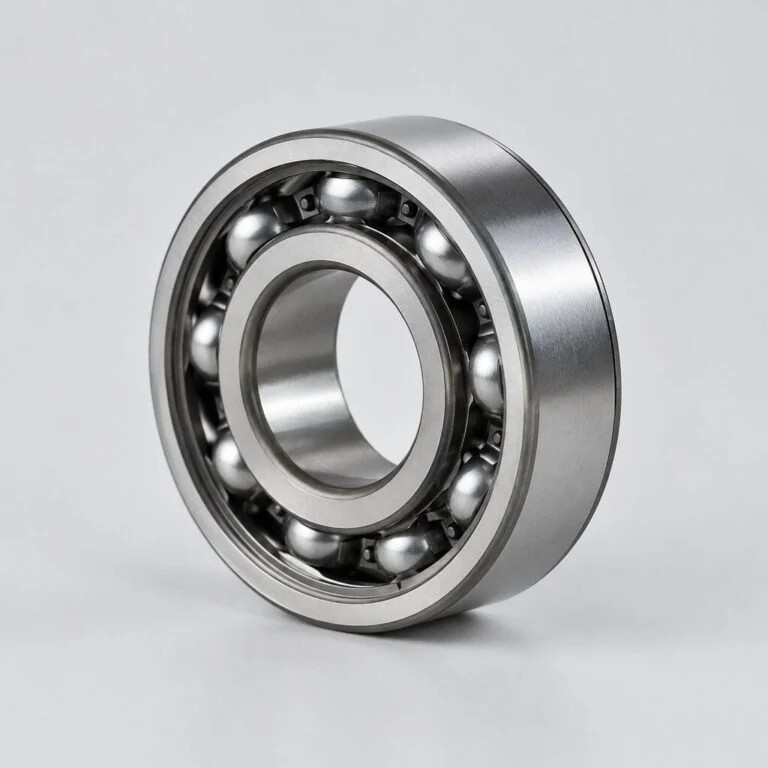
| Bearing Type | Angular Contact Ball Bearing |
| Series | B719 |
| Bore Diameter (d) | 65 mm |
| Outside Diameter (D) | 90 mm |
| Width (B) | 13 mm |
| Precision Class | P4s |
| Contact Angle | 15° |
| Material | Steel |
| Arrangement | Single-Row Bearing |
| Origin | Jiangsu China |
Note: Suffixes T and UL require manufacturer catalog confirmation for exact cage material and preload pairing specifics.
Application Suitability
| Industry | Typical Applications |
|---|---|
| Machine Tool Manufacturing | High-speed machining center spindle assemblies |
| Precision Engineering | CNC lathe main shaft and rotary table drives |
| Fluid Machinery | High-speed pump rotor support systems |
| Robotics | Articulated joint actuators requiring low runout |
Micro-Vibrations Destroy Surface Finishes Before the FAG B71913-C-T-P4s-UL angular contact ball bearing Fails
Spindle chatter often stems from mismatched precision tolerances rather than outright bearing collapse.
I learned this the hard way early in my export career when a batch of spindle bearings shipped with standard precision instead of the specified ultra-high class. The machines assembled with them suffered severe chatter, ruining surface finishes and triggering immediate returns. Since then, matching the exact precision class and preload for the FAG B71913-C-T-P4s-UL angular contact ball bearing has become a non-negotiable checkpoint. When high-speed cutters engage the workpiece, any microscopic deviation in the bearing raceway translates directly into visible marks on the metal. Procurement teams often focus solely on the basic dynamic load rating, overlooking how ultra-high precision geometry dictates the actual machining quality. Preventing these costly micro-vibration failures requires a meticulous alignment of the bearing's internal architecture with the spindle's dynamic behavior.
Aligning Ultra-High Precision with Spindle Dynamics
High-speed machining demands exceptional rotational stability, which is exactly where this FAG B71913-C-T-P4s-UL angular contact ball bearing excels. The tight dimensional tolerances ensure the spindle runs true under varying cutting forces, maintaining the exact tool tip position throughout the machining cycle. Our engineering team routinely cross-checks these specific precision requirements against your machine's operational profile to guarantee optimal fitment. We analyze the specific rigidity requirements of the spindle housing to ensure the bearing outer ring is supported correctly, preventing any deflection that could compromise the P4s accuracy. This comprehensive approach ensures that the theoretical precision of the component is fully realized in the physical assembly.
Navigating Thermal Growth and Radial-Axial Loads
Spindle assemblies generate significant friction heat, which directly impacts internal clearance and lubricant life. A 15° contact angle handles combined loads while minimizing friction heat compared to steeper angles, allowing the spindle to reach higher rotational speeds without thermal seizure. Proper lubrication intervals and matching the thermal expansion of the housing are critical to prevent preload loss during continuous operation. Sealing arrangements must also balance contamination exclusion with low friction to avoid exacerbating thermal growth in the confined spindle cartridge. Engineers must carefully calculate the initial preload to compensate for the differential thermal expansion between the steel bearing rings and the typically cast iron or aluminum spindle housing.
Decoding the B719 Series Engineering DNA
The B719 series indicates a specific dimensional cross-section optimized for high-speed, light-to-medium load applications where space is constrained but rigidity is paramount. The 'C' suffix confirms a 15° contact angle, providing the ideal balance between axial rigidity and high-speed capability by reducing the sliding friction within the contact ellipse. P4s precision denotes ultra-high running accuracy, strictly controlling inner and outer ring runout to eliminate high-frequency vibration that plagues standard grade components. The single-row steel construction offers the foundational rigidity needed for precision equipment, while the specific internal geometry is honed for minimal friction. Understanding these specific design choices allows maintenance teams to predict the bearing's behavior under varying load spectrums and adjust the machine parameters accordingly.
The Cascade Effect of Tolerance Mismatches
Installing a bearing with inadequate precision or incorrect preload in a high-speed spindle leads to premature fatigue and catastrophic damage to the shaft journal. According to failure analysis frameworks, improper fitment and tolerance stacking are primary drivers of early spalling and raceway wear. This results in unplanned downtime, scrapped workpieces, and voided machine warranties, far exceeding the initial component cost. A slight mismatch in the shaft seat diameter can induce excessive hoop stress, distorting the inner ring and instantly negating the P4s precision benefits. Recognizing these hidden costs shifts the procurement focus from mere unit price to total cost of ownership and operational reliability.
Securing Genuine Traceability for Critical Spindles
Sourcing ultra-high precision components requires absolute certainty in origin and handling. We provide complete batch traceability documentation for every FAG B71913-C-T-P4s-UL angular contact ball bearing, ensuring you receive genuine factory-sealed units. Our technical team verifies the exact suffix combinations, preventing the costly mistake of substituting standard clearance for specialized preload setups. Furthermore, our flexible consolidation allows you to mix these critical spindle units with general MRO bearings in a single shipment, optimizing your logistics without compromising on authenticity. We also conduct rigorous incoming inspections to verify the anti-counterfeit labels and packaging integrity, ensuring the components have not been subjected to improper storage conditions during transit.
Documentation & Authenticity
- Certificate of Conformity verifying the P4s precision class and origin.
- Original batch traceability records linking the physical unit to the factory production run.
- Official manufacturer app QR code validation for anti-counterfeit assurance.
- Dimensional and running accuracy inspection reports confirming tight P4s runout tolerances.
Storage, Handling & Mounting
- Retain the original vacuum-sealed packaging until the exact moment of mounting to protect the P4s precision raceways from microscopic dust.
- Use clean, lint-free gloves when handling the single-row bearing to prevent sweat-induced corrosion on the high-polish steel surfaces.
- Strictly follow the manufacturer's induction heating guidelines for the inner ring to preserve the precise 15° contact angle alignment during press-fitting.
- Maintain a climate-controlled storage environment to prevent thermal shock that could subtly alter the ultra-high precision dimensional tolerances.
Preparing Your Technical Data for Selection Review
To ensure this spindle bearing perfectly matches your application, please share your specific radial and axial load profiles, maximum operating speeds, and target operating temperatures. Providing the exact OEM machine model number allows our engineers to perform a rigorous cross-reference check against the original equipment manufacturer's specifications. This data enables us to validate the L10 life calculation and confirm the optimal preload arrangement for your specific machining duties. We also evaluate the stiffness requirements of your spindle cartridge to recommend the most appropriate mounting configuration, ensuring the bearing operates within its designed kinematic boundaries.
Frequently Asked Questions
Q: What distinguishes P4s precision from standard P4 or ABEC 7 grades?
A: P4s represents an ultra-high precision tier with stricter tolerances on running accuracy and dimensional variations than standard P4. This tighter control minimizes high-frequency vibrations, which is critical for achieving superior surface finishes in high-speed machine tool spindles where even microscopic runout causes visible chatter marks.
Q: How does the 15° contact angle affect spindle performance compared to 25°?
A: A 15° contact angle generates less friction heat and offers higher speed capabilities, making it ideal for high-speed milling spindles. Conversely, a 25° angle provides greater axial rigidity for heavy-duty turning. Selecting the correct angle ensures the spindle maintains stability under its specific cutting force profile.
Q: What do the unverified suffixes in the designation imply for installation?
A: Suffixes like T and UL typically denote specific cage materials, preload levels, or universal pairing arrangements. It is crucial to confirm these exact parameters via the official catalog before mounting, as incorrect preload application can instantly destroy the bearing's ultra-high precision geometry and cause immediate thermal failure.
Q: How can we verify the authenticity of these FAG spindle bearings?
A: Authenticity is confirmed through multiple layers, including scanning the official QR code on the packaging using the manufacturer's app. We also supply original batch traceability documentation and dimensional inspection reports, ensuring the physical bearing matches the factory's P4s production records and has not been repackaged or counterfeited.
Q: What lubrication practices are recommended for high-speed spindle applications?
A: High-speed spindles typically require precise oil-air or oil-mist lubrication systems to manage friction heat without causing churning losses. The lubricant type and exact dosing intervals must be calibrated to the bearing's speed factor and the 15° contact angle to maintain the hydrodynamic film and prevent premature raceway wear.