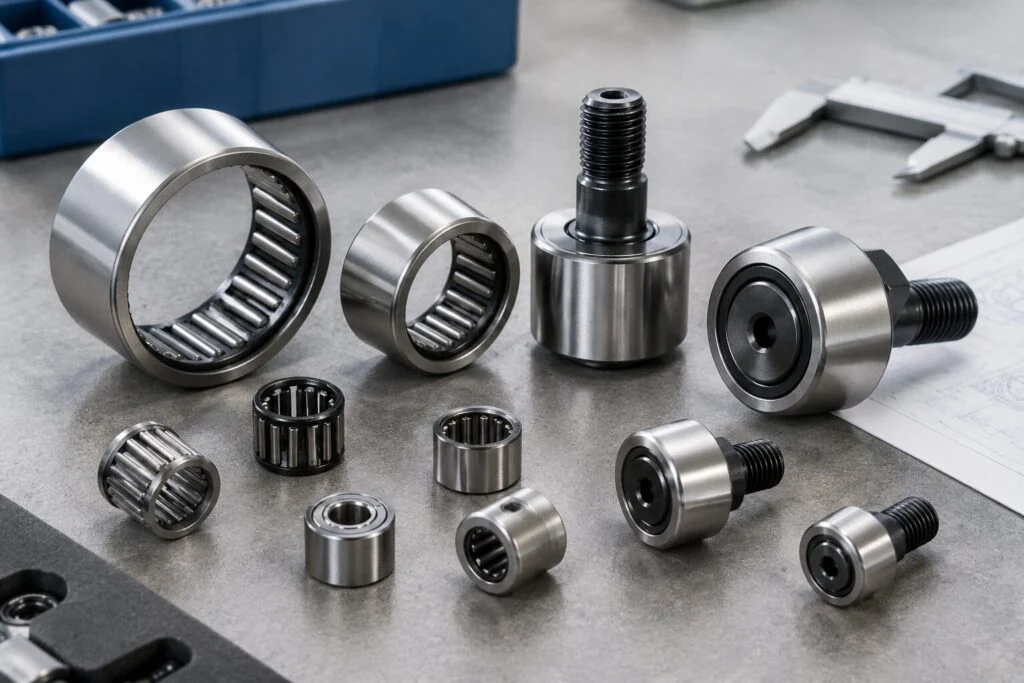
Needle Bearing Shaft Tolerance Table: Wholesale Supplier
Tighter is not better.
The correct shaft tolerance for needle bearings is typically an interference fit using ISO j6, k6, or m6 classes, depending on load conditions. This ensures the thin-walled outer race remains stationary while allowing sufficient internal clearance for lubrication. Deviating from these standards by machining shafts too large eliminates internal clearance, leading to immediate seizure, while undersized shafts cause fretting corrosion and premature fatigue failure.
I still remember the humidity in that workshop in southern Brazil. The air was thick with the smell of burnt oil and metal dust. A batch of agricultural machinery had just rolled off the line, and within weeks, the main drive assemblies were locking up. The local team blamed the bearings. They pointed at the needle rollers, claiming poor quality steel or inadequate heat treatment. I pulled out my micrometer and measured the shaft journals. The deviation was microscopic, barely visible to the naked eye, but it was enough. The customer had machined the shafts to a tolerance that was too tight for the specific bearing class they selected. The internal clearance vanished. The rollers had nowhere to go but to crush against each other. That day reinforced a truth I carry into every technical consultation: the bearing is only as good as the shaft it sits on. [NEED_CITE: common causes of needle bearing failure related to shaft fit]
Understanding this dynamic is critical for any procurement specialist or engineer managing inventory. When you source components, the datasheet is not just a formality; it is the boundary between reliable operation and catastrophic downtime. This guide breaks down how to read the Shaft Tolerance Table for Needle Bearings, avoid common machining pitfalls, and select the right fit for your application.
Why Shaft Tolerance is Critical for Needle Bearings?
Needle roller bearings are distinct from their ball-bearing cousins. They have a high load-carrying capacity relative to their size, but this comes with a structural trade-off: minimal cross-sectional height. The outer ring is often thin, and in many designs, there is no inner ring at all, meaning the needle rollers run directly on the shaft surface. This geometry makes them exceptionally sensitive to shaft deviations.
If the shaft diameter varies even slightly beyond the specified tolerance, the consequences are immediate. An oversized shaft compresses the bearing internals. In a standard deep-groove ball bearing, you might get away with a slight mismatch due to the flexibility of the cage and balls. In a needle bearing, the rigid needles jam. The friction coefficient spikes, heat builds up rapidly, and the lubricant film breaks down. [NEED_CITE: thermal expansion effects on bearing interference fits]
Conversely, an undersized shaft creates a loose fit. Under heavy radial loads, the bearing ring will rotate on the shaft instead of staying stationary. This micro-movement grinds away the metal surfaces, a phenomenon known as fretting corrosion. It creates black oxide debris that contaminates the lubricant and accelerates wear. For OEMs and MRO buyers, verifying the Shaft Tolerance Table for Needle Bearings before production begins is the most effective way to prevent these failures. It is not about buying expensive bearings; it is about ensuring the housing and shaft are prepared to support them.
How to Read the Shaft Tolerance Table (ISO 286)?
The global standard for defining these limits is ISO 286. It can look intimidating if you are not used to reading geometric dimensioning and tolerancing charts, but it follows a logical system. The table defines two main variables: the fundamental deviation (letter code) and the tolerance grade (IT number).
For needle bearings, the letter code indicates the position of the tolerance zone relative to the nominal shaft size.
- j6 and k6: These are transition fits. They provide a slight interference or a very tight clearance. They are ideal for normal operating conditions where loads are moderate and vibration is low.
- m6 and n6: These are interference fits. They ensure a tight grip on the shaft. These are necessary for heavy loads, shock loads, or applications where the inner ring must rotate with the shaft without slipping.
The IT number (e.g., 6 in j6) defines the width of the tolerance zone. A lower number means tighter precision. For most industrial applications involving needle bearings, IT6 is the standard requirement. Going to IT5 increases cost significantly with diminishing returns, while IT7 is often too loose for high-precision applications.
When you consult a Shaft Tolerance Table for Needle Bearings, you are looking for the intersection of your shaft diameter range and the desired fit class. For example, a 20mm shaft with a k6 tolerance might allow a deviation of +2 to +15 microns. This small window is critical. If your machine shop holds a tolerance of +/- 20 microns, you are already outside the safe zone. [NEED_CITE: ISO 286-1 standard tolerance grades explanation]
Recommended Shaft Fits for Different Applications
Selecting the right fit is not a one-size-fits-all decision. It depends on the mechanical environment. Here is how to match the tolerance class to the application reality.
| Application Type | Load Condition | Rotation | Recommended Shaft Fit | Reasoning |
|---|---|---|---|---|
| General Machinery | Moderate | Inner Ring Rotating | k6 | Balances ease of assembly with sufficient grip to prevent creep. |
| Heavy Equipment | High/Shock | Inner Ring Rotating | m6 or n6 | Prevents ring rotation under high torque and shock loads. |
| Precision Instruments | Low/Constant | Stationary Outer | j6 | Allows for easier disassembly while maintaining alignment. |
| Automotive Transmissions | Variable/High | Inner Ring Rotating | k6 or m6 | Handles thermal expansion and variable load cycles effectively. |
Note that these recommendations assume standard operating temperatures. If the application involves significant heat generation, thermal expansion must be considered. A shaft that expands more than the bearing inner ring can loosen the fit, turning a perfect k6 fit into a loose slip fit during operation. In such cases, moving to an m6 fit provides a safety margin. [NEED_CITE: bearing fit selection guidelines for thermal conditions]
A mining conveyor operator once faced repeated failures on idler rollers. The initial design used a j6 fit, assuming light loads. However, the material being transported was denser than anticipated, creating higher radial forces. The inner rings began to creep on the shafts. By switching to an m6 fit, the interference increased, locking the bearing in place and extending service life noticeably. This adjustment required no change in bearing model, only a revision in the shaft machining specification.
Common Machining Mistakes and How to Avoid Them
Even with the correct tolerance class selected, manufacturing errors can ruin the fit. The most common issue is geometric error. A shaft might measure correctly at one point but be out-of-round or tapered along its length. Needle bearings are long and narrow; they bridge these imperfections poorly. If a shaft is oval, the bearing will pinch at the major axis and gap at the minor axis, leading to uneven load distribution and early fatigue.
Surface roughness is another critical factor. The shaft surface where the needle rollers run must be smooth. A rough surface acts like sandpaper, wearing down the rollers and generating heat. The recommended surface roughness (Ra) is typically very low, often requiring grinding rather than turning. [NEED_CITE: surface roughness requirements for bearing shafts]
I recall a project in Central Asia where a factory was rebuilding gearboxes. They sourced high-quality bearings but used turned shafts with visible tool marks. The bearings failed prematurely due to surface abrasion. Switching to ground shafts resolved the issue. It is not enough to hit the diameter target; the form and finish must also meet the standard.
When sourcing from multiple suppliers, consistency is key. Mixing brands with different internal clearance classes (C2, C3, etc.) without adjusting the shaft fit can lead to unpredictable results. Always verify the specific clearance class of the bearing and match it to the corresponding shaft tolerance. Our technical team frequently assists clients in cross-referencing these specifications to ensure that the Shaft Tolerance Table for Needle Bearings is applied correctly across mixed-brand inventories.
Conclusion
Precision matters more than brand.
Selecting the right bearing is only half the battle; ensuring the shaft is machined to the correct tolerance is what guarantees performance. By adhering to ISO standards like j6, k6, and m6, and paying attention to surface finish and geometric accuracy, you can prevent the majority of premature bearing failures. Whether you are managing a large-scale OEM production line or handling urgent MRO replacements, verifying these technical details saves time, money, and operational headaches. Always consult the specific manufacturer’s catalog for the final word on fitment, as internal clearances can vary between series.