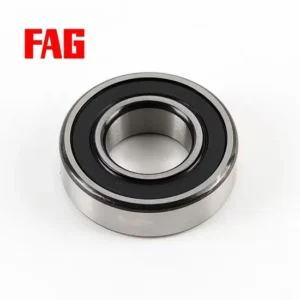
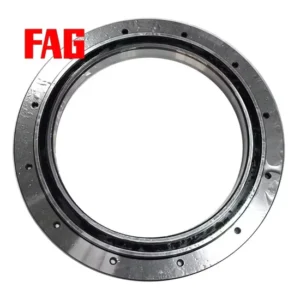
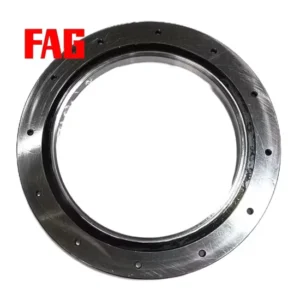
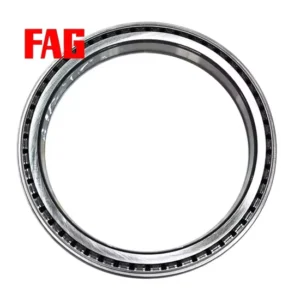
Product Details
About This INA Bearing
Authenticity via QR — Every FAG B71926-C-T-P4s-UL angular contact ball bearing we ship includes an official app QR code for immediate origin verification.
Technical Specifications
| Parameter | Value |
|---|---|
| Designation | FAG B71926-C-T-P4s-UL |
| Bearing Type | Angular Contact Ball Bearing |
| Bore Diameter (d) | 130 mm |
| Outside Diameter (D) | 180 mm |
| Width (B) | 24 mm |
| Precision Class | P4s |
| Contact Angle | 15° |
| Material | Steel |
| Origin | Jiangsu China |
Note: Suffixes T and UL are unverified and require manufacturer catalog confirmation for exact cage and preload specifics.
Application Suitability
| Industry | Typical Applications |
|---|---|
| Machine Tool Manufacturing | High-speed motorized spindles and precision grinding heads |
| Robotics & Automation | High-precision rotary joints and servo motor assemblies |
| Industrial Pumps | High-speed shaft supports requiring low friction heat |
Why Spindle Vibration Spikes When Ignoring the FAG B71926-C-T-P4s-UL angular contact ball bearing Preload
Mismatched preload clears the internal gap, causing the rolling elements to skid and overheat at high RPMs.
During my years handling machine tool after-sales in Suzhou, I witnessed numerous spindle burnouts caused by improper bearing setup. When maintenance teams replaced precision spindle bearings with lower-grade alternatives or skipped preload adjustment, the high-speed operation generated excessive vibration, eventually leading to catastrophic seizure. The internal clearance must be strictly controlled to maintain rotational stability under heavy cutting loads. If the preload is too light, the balls will skid across the raceways, generating localized hot spots that rapidly degrade the lubricant. Conversely, excessive preload creates immense friction heat, causing thermal expansion that further tightens the clearance in a destructive feedback loop. Proper matching of the internal geometry is non-negotiable to prevent these failure modes.
Matching the Target Operating Environment
Selecting the right FAG B71926-C-T-P4s-UL angular contact ball bearing involves more than just matching physical dimensions; it requires aligning the internal geometry with the spindle's thermal and dynamic profile. Machine tool spindles demand exceptional rigidity and rotational accuracy, which means the bearing must withstand complex combined loads without deflecting. Our engineering team provides comprehensive cross-reference alignment and technical selection support to ensure the chosen configuration handles the specific axial and radial loads of your machining center. We analyze the anticipated cutting forces and speed profiles to recommend the optimal mounting arrangement, ensuring the spindle maintains its surface finish quality throughout prolonged production runs.
Operational Challenges and Performance Demands
Machine tool spindles subject bearings to intense combined loads while operating at extreme rotational speeds, generating significant friction heat within the contact zones. This thermal expansion directly impacts the internal clearance, making the initial preload setting absolutely critical for maintaining geometric accuracy during heavy cuts. Furthermore, the lubrication method—whether oil-air mist or specialized high-speed grease—must be carefully matched to the speed factor to prevent thermal runaway and lubricant starvation. Contamination from water-soluble coolants or microscopic metal fines also demands strict sealing protocols and cleanroom assembly practices to protect the highly polished precision raceways from abrasive wear.
Decoding the Core Engineering Specifications
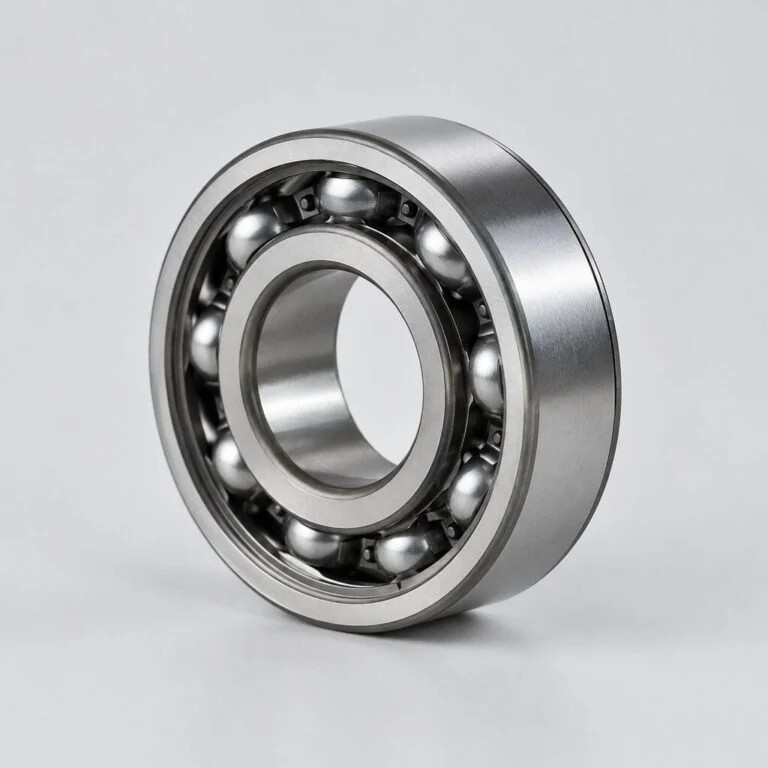
The 15° contact angle designated by the C suffix is specifically engineered to minimize friction heat compared to higher-angle variants, making it exceptionally suitable for high-speed spindle applications where thermal stability is paramount. Achieving P4s precision ensures tighter dimensional and running accuracy than standard P5 classes, directly translating to reduced radial runout and superior surface finishes on complex machined parts. The single-row angular contact design requires these bearings to be mounted in matched sets—such as back-to-back or face-to-face arrangements—to properly absorb bidirectional axial thrust and maintain structural rigidity under heavy milling forces. The steel construction provides the necessary core hardness and fatigue resistance to endure millions of stress cycles, while the specific cage design ensures consistent rolling element spacing to minimize vibration at peak velocities.
The Hidden Costs of Incorrect Selection
Installing an improperly specified bearing in a precision spindle inevitably leads to unplanned downtime and premature failure, disrupting tightly scheduled production environments. When the precision class or contact angle fails to match the original equipment requirements, the resulting vibration degrades the machining accuracy and accelerates wear on adjacent spindle components. According to established failure analysis frameworks, such misapplications often result in catastrophic damage to the spindle housing and drive motors, voiding equipment warranties and necessitating complete assembly replacements. The financial impact extends far beyond the cost of the replacement bearing, encompassing lost production hours, scrapped parts, and extensive labor for spindle rebuilding.
Why Source Through Our Supply Network
Sourcing authentic precision components requires a supply chain that prioritizes strict traceability over mere inventory availability. We maintain massive spot inventory covering thousands of standard part numbers, ensuring that urgent maintenance requirements for your machining centers are met without enduring typical multi-week lead times. Our flexible minimum order quantities accommodate everything from single-unit emergency spare parts to full container consolidation shipments for large-scale facility upgrades. Additionally, our technical team provides in-depth cross-brand equivalent model consultation, preventing costly mismatches when substituting specific preload or clearance variants across different manufacturer catalogs. This comprehensive support ensures that your maintenance team receives the exact configuration needed to restore the spindle to its original factory specifications.
Documentation & Authenticity
- Certificate of Conformity confirming P4s tolerance standards for this specific batch.
- Original factory batch traceability linking the bearing to its production date.
- Official app QR verification for immediate authenticity checks upon delivery.
- Material inspection reports validating the steel composition of the rings and rolling elements.
- Running accuracy inspection confirming dimensional stability before shipment.
Storage, Handling & Mounting
- Keep the matched set sealed until mounting; opening early risks losing the factory preload pairing marks on this arrangement.
- Use clean, lint-free gloves when handling the P4s precision raceways to prevent moisture-induced micro-corrosion.
- Store the bearing in its original packaging with strict humidity control to protect the anti-corrosion coating.
- Apply induction heating for the inner ring installation, strictly monitoring temperature to preserve the P4s dimensional accuracy.
- Verify the spindle housing bore and shaft seat dimensions match the ISO tolerances before pressing the 130mm bore.
Requesting Technical Verification
To ensure optimal spindle performance and longevity, please share your specific operating parameters, including detailed radial and axial loads, maximum continuous RPM, and expected operating temperature ranges. Providing the original equipment manufacturer part number or the existing spindle drawing allows our engineering team to perform a precise cross-reference check. We will then verify the L10 life calculation and recommend the most suitable mounting arrangement and lubrication strategy for your specific machining application, ensuring reliable operation under your exact production conditions.
Frequently Asked Questions
Q: How can I verify the authenticity of this spindle bearing through official channels?
A: Every genuine unit we supply features an official QR code on the packaging. By scanning this code with the manufacturer's official mobile application, you can instantly verify the production batch, origin, and authenticity, ensuring the component meets the strict traceability requirements for precision machine tool maintenance.
Q: How does P4s precision compare to standard P4 or P5 classes in ISO standards?
A: The P4s classification denotes a specialized precision tier that typically offers tighter running accuracy and dimensional tolerances than standard P4 or P5 grades. This enhanced precision is critical for high-speed machine tool spindles, where even microscopic runout can severely compromise the surface finish and dimensional accuracy of the machined parts.
Q: What are the cross-reference considerations for precision and mounting arrangements?
A: When substituting this bearing, it is crucial to match not only the physical dimensions but also the contact angle, precision class, and specific preload settings. Our technical team reviews your existing spindle configuration to ensure the replacement set maintains the required rigidity and thermal stability for your specific machining operations.
Q: What are the recommended lubrication practices for high-speed spindle applications?
A: High-speed spindles typically require specialized oil-air lubrication or high-speed spindle grease to manage friction heat. The lubrication interval and quantity must be carefully calibrated based on the spindle's maximum RPM and the bearing's speed factor to prevent thermal expansion from altering the critical internal preload.