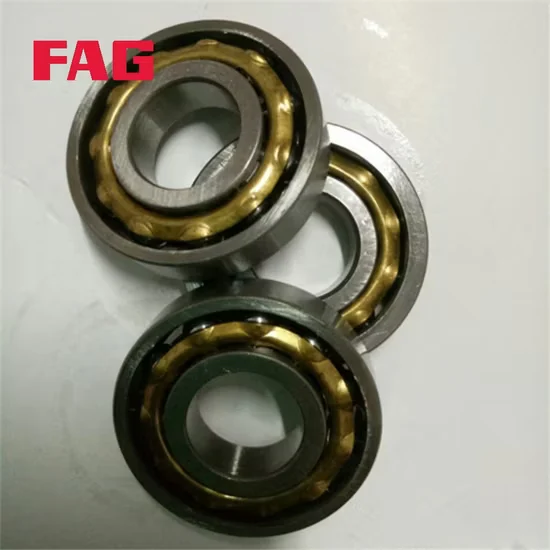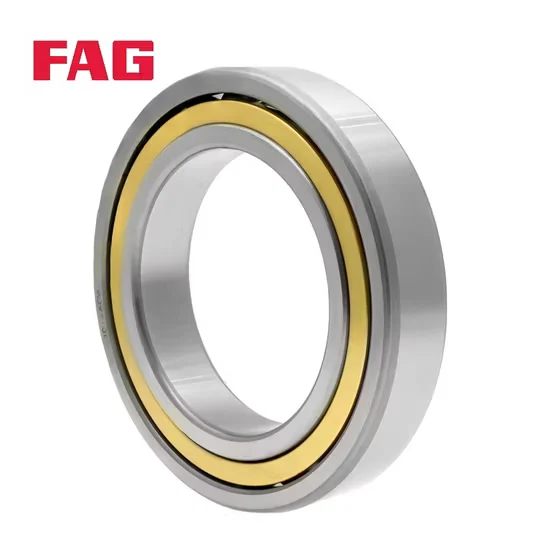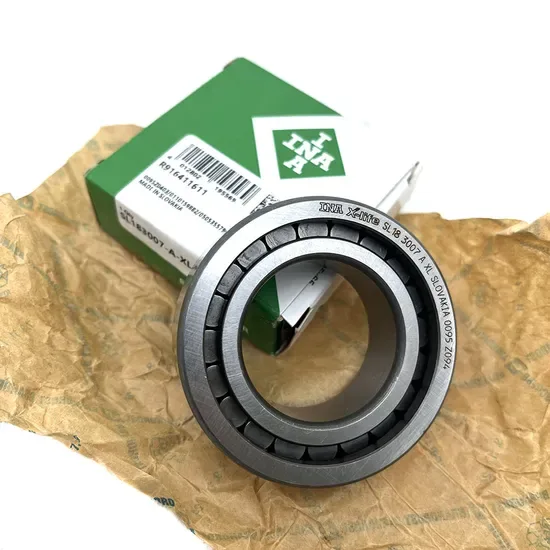


Product Details
About This INA Bearing
Verified Spindle Precision — Every FAG B7028-E-T-P4s-UL angular contact ball bearing ships with an official app QR code for instant authenticity validation.
Technical Specifications
| Parameter | Value |
|---|---|
| Designation | B7028-E-T-P4s-UL FAG |
| Bearing Type | Angular Contact Ball Bearing |
| Bore Diameter (d) | 140 mm |
| Outside Diameter (D) | 210 mm |
| Width (B) | 33 mm |
| Precision Class | P4s |
| Contact Angle | 25° |
| Material | Bearing Steel |
| Seal or Shield Type | Open |
| Arrangement | Single-Row |
Application Suitability
| Industry | Typical Applications |
|---|---|
| Machine Tool Manufacturing | High-speed spindle assemblies for CNC lathes and milling centers |
| Precision Engineering | Rotary tables and indexing heads requiring tight runout tolerances |
| Fluid Power Systems | High-speed pump shafts demanding rigid axial support |
Why Spindle Vibration Often Traces Back to Suffix Mismatches on the FAG B7028-E-T-P4s-UL angular contact ball bearing
A missing or misread preload suffix turns a precision component into a vibration source.
Early in my career handling customs documentation in the Yangtze River Delta, I processed a batch of spindle bearings where the buyer only specified the base model B7028. Ignoring the preload and precision suffixes led to severe spindle vibration after installation, forcing an emergency airfreight rescue with the correct components. This painful lesson proved that verifying the complete designation of the FAG B7028-E-T-P4s-UL angular contact ball bearing is non-negotiable. A minor suffix discrepancy completely alters the internal geometry, transforming a high-precision component into a catastrophic vibration source that ruins machined parts.
Matching the 25° Contact Angle to Spindle Axial Loads
The 25° contact angle designated by the E suffix optimizes axial load capacity without sacrificing radial rigidity. When configuring machine tool spindles, this specific geometry absorbs the thrust generated during heavy milling operations. Our technical team frequently assists clients in cross-referencing this contact angle against their existing spindle layouts to ensure the load vectors align perfectly with the internal contact points.
Navigating Thermal Expansion and Lubrication in High-Speed Machining
High-speed spindles generate significant friction heat, which directly impacts internal clearance and lubrication film thickness. An open bearing design allows for precise oil-air or oil-jet lubrication, essential for dissipating heat at elevated rotational speeds without the churning losses associated with sealed variants. The P4s precision class ensures that dimensional deviations remain minimal even as the inner and outer rings expand at different rates under thermal load. Selecting the correct lubrication interval and viscosity prevents the fluid from breaking down under continuous thermal stress, thereby protecting the raceway integrity.
Decoding the P4s Precision and 25° Contact Angle Architecture
The P4s precision class indicates tight tolerances for both dimensional accuracy and running precision, which is critical for minimizing runout in precision equipment. The E suffix confirms the 25° contact angle, providing a balanced load distribution for combined loading scenarios in high-speed spindles. This specific geometry allows the bearing to absorb significant axial thrust while maintaining the radial rigidity required for fine surface finishes. The single-row steel construction delivers reliable performance under the continuous rotational stress typical of CNC machining environments, ensuring consistent part quality over extended production runs.
The Hidden Costs of Ignoring Preload and Precision Tolerances
Installing a standard precision bearing in a high-speed spindle designed for P4s tolerances inevitably leads to premature failure. Without the correct internal clearance and preload, the rolling elements experience skidding, which rapidly degrades the raceway surface and generates excessive heat. This unplanned downtime not only halts production but can also cause catastrophic damage to the spindle housing, motor, and adjacent tooling. Warranty voidance is almost guaranteed when failure analysis reveals that the installed component did not match the original equipment manufacturer's exact suffix and precision requirements.
Securing Exact Suffix Matches for Critical Spindle Applications
Sourcing the exact FAG B7028-E-T-P4s-UL angular contact ball bearing requires more than just finding the base model in stock. Our massive spot inventory covers thousands of specific suffix combinations, preventing the costly delays associated with substituting incorrect preload classes or precision grades. We provide complete traceability documentation for every shipment, ensuring the metallurgical and dimensional integrity of the steel components. When official brand channels face extended lead times, our flexible consolidation shipping and cross-brand equivalent consultation offer a reliable alternative. This approach guarantees the strict ISO-compliant quality assurance your spindles demand without compromising on exact technical specifications.
Documentation & Authenticity
- Certificate of Conformity verifying the P4s precision class and ISO 492 compliance.
- Original batch traceability codes linking the steel material to the manufacturer's production facilities.
- Official app QR verification for instant authentication of the bearing packaging and labels.
- Dimensional and running accuracy inspection reports confirming tight runout tolerances before dispatch.
- Material test certificates validating the bearing steel composition and heat treatment hardness.
Storage, Handling & Mounting
- Store the open bearing in its original vapor-phase inhibitor packaging to prevent micro-corrosion on the precision raceways.
- Maintain a climate-controlled environment to protect the P4s tolerance rings from thermal distortion before mounting.
- Use lint-free cleanroom gloves when handling the exposed steel rolling elements to avoid acidic skin contamination.
- Apply induction heating strictly to the inner ring during mounting to preserve the precise 25° contact angle geometry.
- Keep the universal pairing marks intact and follow the manufacturer's sequence to achieve the correct internal preload.
Engineering Review for Spindle Integration
To ensure the selected bearing perfectly matches your spindle design, please share your specific radial and axial load profiles along with the maximum operational speed. Providing the original equipment manufacturer's part number allows our engineering team to perform a precise cross-reference check. We also recommend detailing your lubrication method and operating temperature range so we can validate the internal clearance and preload configuration for your exact application.
Frequently Asked Questions
Q: What does the P4s precision class mean for this spindle bearing?
A: The P4s designation indicates that the bearing meets extremely tight dimensional and running accuracy tolerances, exceeding standard P4 requirements in certain parameters. This high precision is essential for machine tool spindles to minimize vibration and ensure superior surface finishes during high-speed machining operations.
Q: How does the 25° contact angle affect spindle performance?
A: The 25° contact angle, indicated by the E suffix, provides an optimal balance between axial load capacity and radial rigidity. This geometry allows the spindle to withstand the significant axial thrust generated during milling and drilling while maintaining the stiffness needed for precise radial positioning.
Q: Can I use standard grease for lubricating this open bearing?
A: Open bearings designed for high-speed spindles typically require specialized oil-air or oil-jet lubrication systems rather than standard grease packing. Proper lubrication selection and delivery are critical to managing friction heat and preventing premature failure at elevated rotational speeds.
Q: How should I handle the unverified suffixes during procurement?
A: Certain suffixes in the designation may require direct confirmation with the manufacturer's latest catalog to ensure exact application fit. We strongly recommend providing your complete spindle specifications so our technical team can verify these specific nomenclature details before finalizing your order.