

Product Details
About This INA Bearing
Cross-reference alignment — verifying bore taper, internal clearance, and cage material prevents catastrophic misalignment in continuous casting lines.
Technical Specifications
| Parameter | Value |
|---|---|
| Designation | FAG 22220-E1-K |
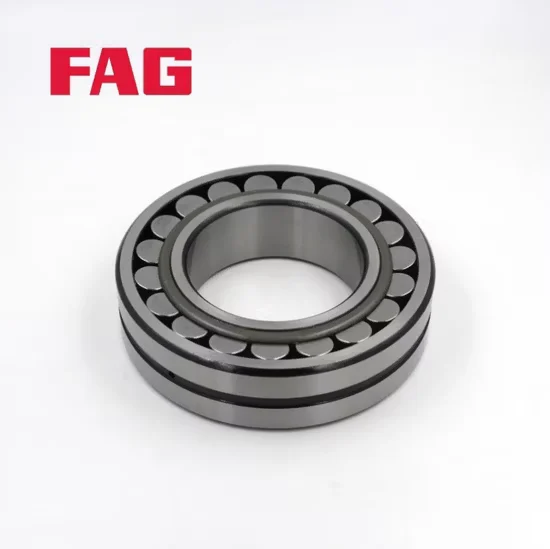
| Bearing Type | Spherical Roller Bearing |
| Number of Rows | Double Row |
| Arrangement | Self-Aligning |
| Bore Type | 1:12 Tapered Bore |
| Cage Material | Steel Cage / Brass Cage / Nylon Cage (Options) |
| Material | Chrome Steel Gcr15 |
| Precision Class | P0 / P2 / P4 / P5 / P6 (Options) |
| Clearance Class | C3 / C4 (Options) |
| Origin | Jiangsu China |
| Customization | Available |
Application Suitability
| Industry | Typical Applications |
|---|---|
| Steel Mills | Continuous casting roll guide segments, ladle turret slewing mechanisms |
| Mining & Aggregates | Vibrating screen exciter mechanisms, jaw crusher eccentric shafts |
| Pulp & Paper | Paper machine dryer cylinder bearings, press roll journals |
Why Spherical Roller Bearings Fail in Continuous Casting Lines
Thermal expansion miscalculation causes more roll line seizures than metallurgical fatigue.
When specifying a FAG 22220-E1-K spherical roller bearing for high-heat environments, selecting standard clearance instead of C3 or C4 often leads to thermal binding. During my years providing on-site service in Suzhou steel mills, I witnessed an entire continuous casting line halt because thermal expansion eliminated the internal clearance, locking the roll solid. The inner ring expands significantly faster than the housing, and without adequate initial clearance, the rolling elements jam against the raceway. This catastrophic seizure destroys the shaft and forces days of unplanned downtime. Properly matching the internal clearance to the specific thermal gradient is the most critical step in preventing these costly production halts.
Matching the Tapered Bore to Heavy-Duty Shaft Configurations
The 1:12 tapered bore design of this FAG 22220-E1-K spherical roller bearing ensures secure mounting on adapter sleeves, which is critical for vibrating screens and crushers experiencing severe shock loads. Unlike cylindrical bores, the tapered interface allows for precise adjustment of the internal radial clearance during the drive-up process. Our engineering team provides cross-brand equivalent model consultation to verify the exact sleeve dimensions, lock nut specifications, and drive-up measurements required for your specific shaft configuration. This rigorous technical validation ensures the bearing achieves the optimal residual clearance, preventing both excessive preload and detrimental looseness during high-vibration operation.
Overcoming High-Temperature and Shock Load Challenges
Equipment in steel mills and mining operations subjects bearings to heavy combined loads and extreme temperature fluctuations. At elevated temperatures, standard radial clearance rapidly diminishes, necessitating C3 or C4 options to maintain the optimal operational gap. Furthermore, the self-aligning capability compensates for shaft deflections under heavy radial loads, protecting the rolling elements from edge stressing. Proper lubrication is equally vital; the outer ring lubrication groove configurations ensure consistent oil film thickness despite continuous particulate contamination common in aggregate processing. When dealing with heavy axial components combined with radial forces, the symmetrical roller design distributes the stress evenly, significantly extending the operational lifecycle of the assembly.
Decoding Cage Materials and Clearance Selections
Selecting the appropriate cage material—whether steel, brass, or nylon—directly impacts the bearing's performance under specific vibration and speed profiles. Brass cages typically offer superior durability and wear resistance in high-vibration environments like vibrating screens, where shock loads can fatigue weaker materials. Steel cages provide a balanced, cost-effective approach for general heavy machinery operating at moderate speeds. The K suffix confirms the 1:12 tapered bore, which demands precise drive-up control during installation to achieve the correct residual clearance. Pairing this tapered bore with C3 or C4 internal clearance is non-negotiable for applications where the inner ring reaches significantly higher temperatures than the outer ring. Understanding these suffix and clearance interactions prevents premature failure caused by incorrect thermal compensation and ensures reliable load distribution across the double-row structure.
The Hidden Costs of Incorrect Clearance and Bore Matching
Installing a standard clearance bearing in a high-heat continuous casting application inevitably results in unplanned downtime and catastrophic damage to the shaft and housing. According to failure analysis frameworks, thermal binding accelerates wear, generates excessive friction heat, and leads to sudden seizure, completely voiding warranties and halting production. Misinterpreting the tapered bore drive-up requirements similarly causes micro-movements, leading to severe fretting corrosion on the adapter sleeve interface. These hidden costs far exceed the initial procurement price, emphasizing the necessity of rigorous technical review before installation.
Securing Authentic Components for Critical Infrastructure
Sourcing genuine components requires strict verification, especially for critical suffixes like the K tapered bore where counterfeit parts often fail dimensional checks and cause immediate mounting issues. We maintain massive spot inventory covering thousands of standard part numbers, ensuring rapid fulfillment for urgent maintenance requirements when a critical crusher or screen goes down. Our supply chain provides complete traceability documentation, allowing you to verify the exact batch codes of your FAG 22220-E1-K spherical roller bearing directly with the manufacturer. We also offer flexible MOQ, from single-unit emergency spares for a broken vibrating screen to full container consolidation for plant-wide upgrades. Furthermore, our technical selection support ensures the C3 or C4 clearance perfectly matches your operational thermal profile, eliminating the guesswork that leads to premature failures.
Documentation & Authenticity
- Certificate of Conformity verifying the exact 1:12 tapered bore geometry and dimensional tolerances.
- Original manufacturer batch code traceability for authenticating the specific cage material and clearance class.
- Material inspection reports confirming the metallurgical integrity of the Chrome Steel Gcr15 rings.
- Running accuracy inspection validating the selected P-class precision before dispatch to steel mills.
Storage, Handling & Mounting
- Store the tapered bore bearing in original packaging to prevent corrosion on the critical 1:12 mating surface.
- Use clean gloves when handling to avoid contaminating the lubrication grooves before installation on adapter sleeves.
- Measure the drive-up distance precisely during mounting to ensure the C3 or C4 residual clearance is maintained.
- Keep brass cage variants protected from severe impacts during storage to prevent cage deformation.
Engineering Review and Technical Validation
To ensure optimal performance and avoid the costly mistakes I have seen on the factory floor, please share your specific radial and axial loads, operating temperatures, and exact shaft dimensions for a comprehensive L10 life calculation. Providing the OEM equipment number allows our engineering team to perform precise cross-reference verification and confirm the exact adapter sleeve compatibility for your tapered bore setup. We will also review your lubrication intervals and contamination levels to recommend the most suitable cage material and seal configuration, ensuring your machinery operates reliably under the most demanding conditions.
Frequently Asked Questions
Q: What does the K suffix indicate for this spherical roller bearing?
A: The K suffix designates a 1:12 tapered bore, allowing the bearing to be mounted securely on adapter sleeves or tapered shafts. This configuration is essential for applications requiring precise clearance adjustments during installation, such as vibrating screens and continuous casting rolls, ensuring tight radial positioning and preventing micro-movements under heavy shock loads.
Q: How do I choose between C3 and C4 internal clearance?
A: The choice depends on the temperature differential between the inner and outer rings. C3 provides greater clearance than standard, suitable for moderate heat, while C4 offers even more compensation for extreme thermal expansion in steel mill equipment. Selecting the correct class prevents thermal binding and ensures a stable operational oil film under high-temperature conditions.
Q: What is the meaning of the E1 suffix in the designation?
A: The E1 suffix generally indicates an optimized internal design with improved load-carrying capacity and enhanced roller guidance. However, as it is an unverified suffix in this specific context, we strongly recommend confirming the exact internal geometry and roller profile through the manufacturer's official catalog or our technical support team before finalizing your procurement.
Q: How can I verify the authenticity of the supplied bearings?
A: We provide complete supply chain traceability documentation, including original manufacturer batch codes and certificates of conformity. You can cross-check these codes using official brand verification tools. Additionally, our dimensional inspection reports confirm the precise 1:12 tapered bore geometry and clearance class, ensuring the component meets strict OEM specifications for heavy-duty applications.