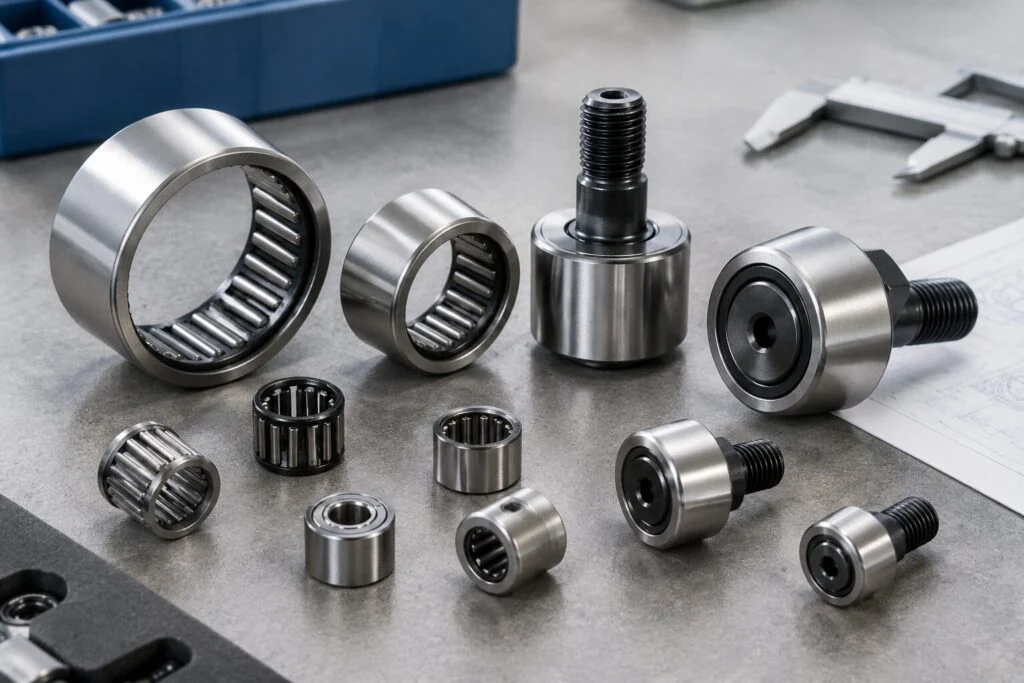
INA Track Rollers for Forklift Masts – Wholesale Supplier
Most mast failures are not caused by overload, but by incorrect internal clearance.
Genuine INA track rollers with precise radial clearance and correct lubrication viscosity are non-negotiable for forklift mast stability. Substituting these critical components with unverified alternatives or selecting the wrong clearance class directly causes catastrophic rail jamming, outer ring spalling, and costly unplanned downtime. For MRO managers and OEM buyers, verifying authenticity through traceability codes and matching the roller specification to the specific mast profile is the only way to ensure operational continuity.
I still remember the silence in a sorting center warehouse at 2 AM. It was not the quiet of efficiency, but the dead stop of a jammed mast. A batch of replacement rollers had been installed just months prior to save on procurement costs. The outer rings had spalled, locking the carriage against the guide rail. The cost of replacing the entire mast assembly and the lost throughput during the repair window dwarfed the initial savings from buying non-genuine parts. That night shifted my focus from simple part swapping to understanding the metallurgy and engineering behind INA track rollers for forklift masts. Since then, I have seen that visual inspection alone is insufficient to guarantee performance; only rigorous technical selection and verified sourcing prevent such failures.
The complexity of modern material handling equipment demands more than just a bearing that fits. It requires a component engineered to withstand dynamic loads, shock impacts, and varying environmental conditions. Understanding why these components fail and how to select the right ones is critical for anyone responsible for fleet maintenance or equipment manufacturing.
Why Do Forklift Masts Jam?
External ring spalling due to poor clearance selection or inadequate lubrication is the primary cause of rail locking.
Many operators assume that if a roller fits into the mast channel, it will work. This is a dangerous misconception. The interaction between the track roller and the mast rail is a high-stress contact zone. When the internal radial clearance is incorrect for the specific load and thermal conditions, the bearing elements cannot distribute stress evenly. Over time, this leads to fatigue spalling on the outer ring. Once a piece of the hardened steel breaks off, it acts as a wedge, jamming the roller against the rail and halting the lift mechanism entirely.
The root cause is often a mismatch between the bearing’s internal clearance and the operational environment. In standard applications, a C3 clearance might suffice. However, in high-frequency operations or environments with significant temperature fluctuations, such as cold-storage facilities, the metal expands and contracts. If the clearance is too tight, thermal expansion eliminates the running gap, causing excessive heat generation and premature failure. If it is too loose, the impact loads from lifting heavy pallets cause micro-movements that degrade the raceways. [NEED_CITE: ISO 15243 failure mode classification for rolling bearings]
I have inspected countless failed rollers from various warehouses. The pattern is consistent: the damage starts internally, invisible to the naked eye until it is too late. The outer ring cracks, flakes, and eventually disintegrates. This is not a manufacturing defect in the majority of cases, but a selection error. Using a standard commercial-grade roller in a heavy-duty forklift mast application ignores the dynamic load ratings required by the equipment designer. The result is always the same: a seized mast and a halted operation.
How to Select the Right INA Track Roller?
Match the load capacity, speed, and mast profile with exact clearance specifications rather than relying on dimensional fit alone.
Selecting the correct INA track rollers for forklift masts requires a detailed analysis of the application parameters. It is not enough to know the outer diameter and width. One must consider the radial clearance, the lubrication type, and the dynamic load rating. The goal is to ensure that the roller can handle the combined radial and axial loads imposed by the mast structure during lifting and tilting operations.
Radial clearance is the most critical parameter. INA offers various clearance classes, such as C3 and C4, which provide greater internal space between the rolling elements and the raceways. This extra space accommodates thermal expansion and slight misalignments common in heavy machinery. For standard warehouse forklifts operating in ambient temperatures, a C3 clearance is often recommended. For extreme conditions, such as foundries or cold storage, a C4 clearance may be necessary to prevent binding or excessive preload. [NEED_CITE: INA technical catalog guidelines for radial clearance selection]
| Selection Factor | Standard Warehouse Application | Heavy-Duty/Extreme Environment |
|---|---|---|
| Radial Clearance | C3 (Standard Increased) | C4 (Extra Increased) |
| Lubrication Type | Standard Lithium Complex Grease | High-Temperature or Low-Temperature Synthetic |
| Load Rating Focus | Dynamic Load Capacity | Static Load Capacity & Shock Resistance |
| Sealing Requirement | Standard Rubber Seals | Enhanced Sealing with Metal Shields |
Lubrication plays an equally vital role. The viscosity of the grease must match the operating temperature. In cold storage, standard greases harden, increasing friction and wear. In hot environments, they thin out, losing their protective film. Choosing the right lubricant ensures that the rolling elements remain separated from the raceways, reducing friction and heat generation. I always advise clients to check the manufacturer’s recommendations for grease compatibility and re-lubrication intervals. Ignoring this step can negate the benefits of even the highest quality bearing.
The mast profile itself also dictates the choice. Some masts have curved rails, while others are flat. The contour of the track roller must match the rail precisely to ensure optimal contact area. A mismatch leads to point loading, which accelerates wear and increases the risk of spalling. Therefore, verifying the original equipment manufacturer’s specifications is essential before making any substitution.
The Hidden Cost of "Alternative" Rollers
Counterfeit or unverified parts lead to rapid spalling, destroying the entire mast guide rail and incurring mid-six-figure losses.
The market is flooded with look-alike rollers that claim to be equivalent to genuine INA products. These alternatives often lack the precise metallurgy and quality control of the original. While they may appear identical externally, their internal structure is frequently inferior. The steel purity is lower, leading to faster fatigue failure. The heat treatment is inconsistent, resulting in soft spots that deform under load.
I once worked with a distributor in Southeast Asia who sourced a large batch of alternative rollers to cut costs. Within six months, multiple forklifts in their client’s fleet experienced mast jams. The investigation revealed that the outer rings of the alternative rollers had spalled extensively, damaging the mast rails. The cost of replacing the rollers was negligible compared to the cost of repairing the masts and the downtime incurred. The total loss was several times the initial savings. This is the hidden cost of using unverified components.
Authenticity cannot be determined by visual inspection alone. High-end fakes are designed to mimic the packaging and markings of genuine products. The only reliable way to ensure authenticity is through traceability documentation and sourcing from authorized channels. Genuine INA track rollers for forklift masts come with batch numbers and material certificates that verify their origin and specifications. Without these documents, buyers are gambling with their equipment’s reliability.
The risk extends beyond financial loss. A failed mast can pose a serious safety hazard to operators. A sudden drop or jam during lifting can cause loads to shift or fall, leading to accidents. Therefore, the integrity of the bearing is not just a maintenance issue, but a safety imperative. Investing in genuine parts is an investment in operational safety and reliability.
How to Verify Genuine INA Rollers in Procurement?
Rely on traceability documents and official channel sourcing, not just visual checks, to prevent high-end fakes.
Verifying the authenticity of INA track rollers for forklift masts requires a systematic approach. Visual cues such as logo clarity and packaging quality are easily replicated by counterfeiters. The true proof lies in the documentation and the supply chain. Every genuine INA product has a unique traceability code that links it to its production batch and material certification. Requesting these documents from suppliers is the first step in verification.
A reliable supplier will provide full traceability without hesitation. This includes material certificates that confirm the steel grade and heat treatment process. It also includes inspection reports that verify dimensional tolerances and radial clearance. If a supplier cannot provide these documents, or if they offer vague explanations, it is a red flag. I always insist on seeing the paperwork before approving any purchase order for critical components.
| Verification Step | Action Required | Expected Outcome |
|---|---|---|
| Documentation Check | Request Material Certificates & Batch Traceability | Full set of verifiable documents provided |
| Supplier Audit | Verify Authorization Status with Brand Principal | Confirmation of authorized distributor status |
| Physical Inspection | Check Markings, Packaging, and Surface Finish | Consistent with brand standards, no irregularities |
| Technical Support | Ask for Application Guidance & Cross-Reference Data | Detailed technical support and accurate data provided |
Sourcing from authorized distributors ensures that the products have been stored and handled correctly. Bearings are sensitive to humidity and contamination. Improper storage can lead to corrosion before the product is even installed. Authorized partners adhere to strict storage guidelines, ensuring that the rollers arrive in pristine condition. They also offer technical support, helping buyers select the right specifications for their specific applications.
In my experience, building a relationship with a trusted supplier is more valuable than chasing the lowest price. A partner who understands the technical requirements and stands behind their products provides peace of mind. They can assist with emergency replacements, offer cross-brand technical advice, and help optimize inventory levels. This collaborative approach reduces the risk of procurement errors and ensures long-term operational stability.
Conclusion
Precision clearance and verified authenticity are the foundations of forklift mast reliability.
Choosing the right INA track rollers for forklift masts involves more than matching dimensions; it requires understanding the interplay of load, clearance, and lubrication. Counterfeit or improperly selected components lead to catastrophic failures that far outweigh any initial cost savings. By prioritizing traceability, adhering to technical specifications, and sourcing from verified partners, MRO managers and OEMs can ensure the longevity and safety of their material handling equipment. The cost of diligence is minimal compared to the price of downtime.