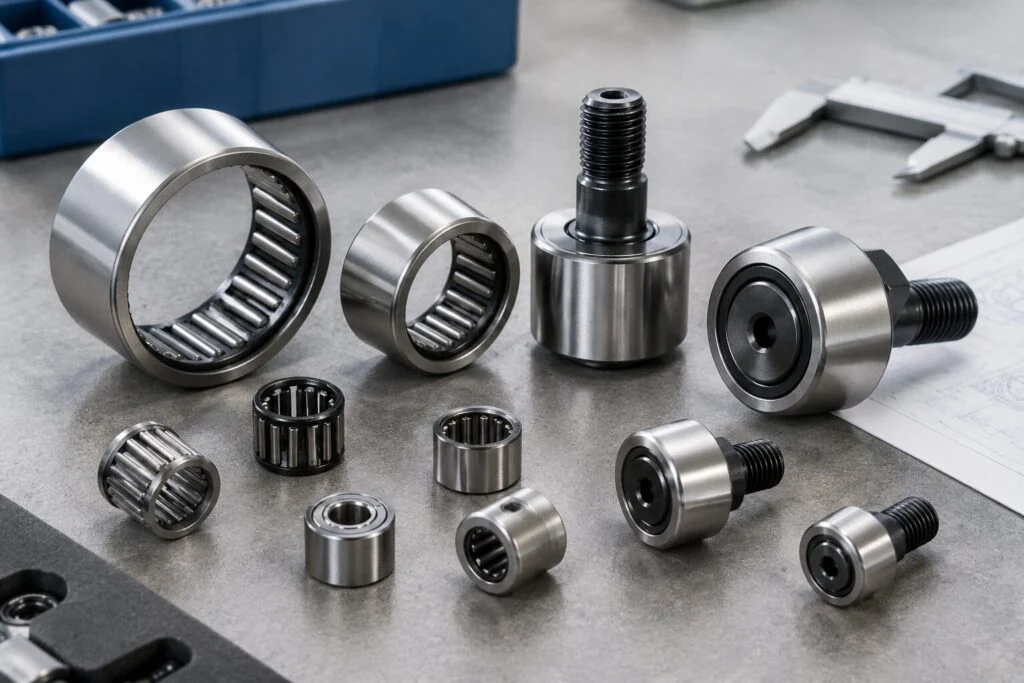
INA Needle Bearings for Power Tools: Wholesale Supplier
Most premature bearing failures in power tools are not manufacturing defects, but logistical and selection errors.
The core answer for sourcing INA needle bearings for power tools is that success depends less on the brand name alone and more on matching the internal clearance to local operating temperatures and implementing redundant vapor-phase corrosion inhibition for long-distance ocean freight. Without these two specific adjustments, even genuine high-precision components will fail before reaching the end-user or seize during initial operation in tropical climates.
I still remember the silence on the phone line from Lagos. A container of angle grinders had arrived at Apapa Port after a customs strike delayed clearance by several weeks. The rainy season was in full swing. When the buyer opened the cartons, the needle rollers inside the spindle assemblies were covered in yellow rust. He refused to pay the balance. It was not a quality issue from the factory floor; it was a packaging failure that ignored the reality of maritime logistics. That loss taught me that selling INA needle bearings for power tools requires looking beyond the technical drawing to the entire supply chain journey. [NEED_CITE: common causes of bearing corrosion during maritime transport]
This experience shifted my focus from simple order fulfillment to technical consultancy. Now, when distributors ask for quotes, I first ask about their destination port and the typical ambient temperature where the tools will be used. This approach prevents the costly disputes that plague international bearing trade.
Why INA Needle Bearings Are Critical for Power Tool Design
The extreme radial load capacity of needle bearings allows power tool manufacturers to minimize housing size without sacrificing durability.
In applications like angle grinders and rotary hammers, space is the most constrained resource. The motor and gear assembly must fit into a handheld form factor, yet they must withstand significant shock loads. Standard ball bearings often require larger cross-sections to handle similar radial forces, which would make the tools bulky and unbalanced. Needle bearings, with their high length-to-diameter ratio of rollers, provide maximum load carrying capacity within minimal radial space. [NEED_CITE: mechanical advantages of needle roller bearings in compact designs]
For a wholesaler, understanding this design constraint is vital. You are not just selling a part; you are enabling a specific engineering outcome. When I supply INA needle bearings for power tools, I am providing a component that allows OEMs to maintain slim profiles while ensuring the spindle can handle the lateral forces generated during grinding or drilling.
Consider the difference in a high-torque demolition hammer. The impact mechanism generates violent axial and radial shocks. A standard deep-groove ball bearing might deform under such stress, leading to noise and vibration. A needle bearing, properly supported by a hardened shaft and housing, distributes the load over a larger contact area. This reduces surface pressure and extends service life significantly.
However, this high load capacity comes with a caveat. Needle bearings are sensitive to misalignment and edge loading. If the housing bore is not machined to precise tolerances, the rollers can skew, causing rapid wear. This is why sourcing from a supplier who understands the interplay between the bearing and the host machine is crucial. It is not enough to have the part number; one must ensure the application environment supports the bearing’s structural requirements.
How to Select the Right Clearance and Seal for Local Conditions
Choosing the correct internal clearance is more critical than pursuing the highest precision grade for high-impact tools.
A common misconception among buyers is that tighter tolerance always equals better performance. In high-speed, high-heat environments like those found in professional-grade power tools, excessive precision can lead to catastrophic failure. As the tool operates, friction generates heat. The inner ring expands faster than the outer ring. If the initial internal clearance is too tight (such as C2), thermal expansion can eliminate the running clearance entirely, causing the bearing to seize.
For INA needle bearings for power tools, selecting a C3 or even C4 clearance is often necessary for applications in hot climates or those involving continuous heavy duty. [NEED_CITE: ISO standards for bearing internal clearance and thermal expansion effects] I once advised a distributor in Southeast Asia who was experiencing high warranty returns on electric planers. The bearings were failing within months. Upon inspection, we found the bearings were seized due to thermal lock-up. Switching from standard clearance to C3 resolved the issue immediately, as it allowed sufficient room for thermal expansion during prolonged use.
Sealing is the second critical factor. Power tools operate in dusty, dirty environments. Wood dust, concrete particles, and metal shavings are abrasive contaminants that destroy bearing surfaces. Open bearings are rarely suitable for final assembly unless the tool housing provides exceptional protection. Sealed needle bearings, with integrated shields or rubber seals, prevent contaminant ingress while retaining lubricant.
| Application Factor | Recommended Clearance | Sealing Requirement | Risk of Incorrect Choice |
|---|---|---|---|
| High-Speed Angle Grinder | C3 | Double Shielded | Seizure due to heat if clearance too tight |
| Rotary Hammer (Impact) | C3 or C4 | Rubber Seal (if space allows) | Contamination ingress if open type used |
| General Purpose Drill | Standard (C0/C2) | Single Shield | Premature wear from dust intrusion |
When specifying INA needle bearings for power tools, always cross-reference the operating temperature range with the clearance table. Do not assume standard clearance is universal. For regions with extreme ambient heat, uprating the clearance is a low-cost insurance policy against field failures.
Preventing Rust During Long-Distance Ocean Shipping
Corrosion during transit is a logistical failure, not a manufacturing defect, and requires redundant protective measures.
The incident in Lagos was not an isolated case. Maritime shipping exposes steel components to high humidity, salt spray, and temperature fluctuations that cause condensation inside packaging. For INA needle bearings for power tools, which are often shipped in bulk to tropical regions, standard oil coating is insufficient for voyages lasting several weeks.
Vapor Phase Corrosion Inhibitor (VCI) technology is essential. VCI emitters release microscopic molecules that settle on metal surfaces, forming a protective molecular layer that blocks moisture. However, relying solely on VCI is risky if the packaging is compromised. A robust strategy involves multiple layers: individual VCI bagging for each bearing, desiccant packs within the master carton, and shrink-wrapping the pallet to create a micro-climate barrier. [NEED_CITE: best practices for VCI packaging in maritime logistics]
I now insist on this redundant protocol for all shipments to high-humidity zones. The cost increase is negligible compared to the value of the cargo and the reputational damage of a rejected shipment. A recent shipment to a distributor in Brazil arrived with zero signs of oxidation, despite a month-long delay at port due to administrative issues. The VCI bags had maintained their integrity, and the desiccants had absorbed the ambient moisture.
Buyers should verify that their supplier uses certified VCI materials and calculates desiccant units based on container volume and expected voyage duration. Do not accept generic "oil paper" wrapping for long-haul sea freight. Insist on visible VCI branding and proper sealing. This attention to detail separates a reliable partner from a mere box mover.
Diagnosing Premature Failure in Field Applications
Most field failures stem from improper installation or lubrication starvation, not inherent material weakness.
When a power tool fails, the instinct is to blame the bearing. However, a forensic look at failed units often reveals installation errors. Needle bearings are press-fit components. If the installation force is applied unevenly, the rollers can be damaged before the tool is even switched on. Using a proper arbor press and ensuring the housing bore is clean and burr-free is critical.
Another common issue is lubrication incompatibility. Some power tool manufacturers use greases that are not compatible with the factory-fill lubricant in sealed bearings. Over time, chemical reactions can thicken the grease, increasing drag and heat. For INA needle bearings for power tools, sticking to the manufacturer’s recommended lubrication specifications is vital. If regreasing is part of the maintenance schedule, ensure the new grease is chemically compatible with the original.
I recall a case with a mining equipment repair shop in Chile. They were rebuilding rock drills and experiencing short bearing life. The issue was not the bearing quality but the cleaning process. Residual solvent from the cleaning bath was mixing with the new grease, breaking down its structure. Changing the cleaning protocol to a thorough drying phase eliminated the problem. This highlights the importance of holistic technical support. A supplier who only ships parts cannot help diagnose these systemic issues.
By understanding these failure modes, distributors can offer better after-sales support to their customers. Providing installation guides and lubrication charts adds value beyond the product itself. It positions the supplier as a technical expert rather than just a vendor.
Conclusion
Sourcing INA needle bearings for power tools demands a holistic view that integrates technical selection with logistical protection.
Success in this niche is not defined by the lowest price per unit but by the reliability of the component in the hands of the end-user. By selecting appropriate clearance for thermal conditions, enforcing robust VCI packaging for maritime transit, and understanding the mechanical demands of high-impact tools, buyers can significantly reduce warranty claims and build trust with their local markets. The right partner provides not just the bearing, but the expertise to ensure it performs as intended from the factory floor to the job site.