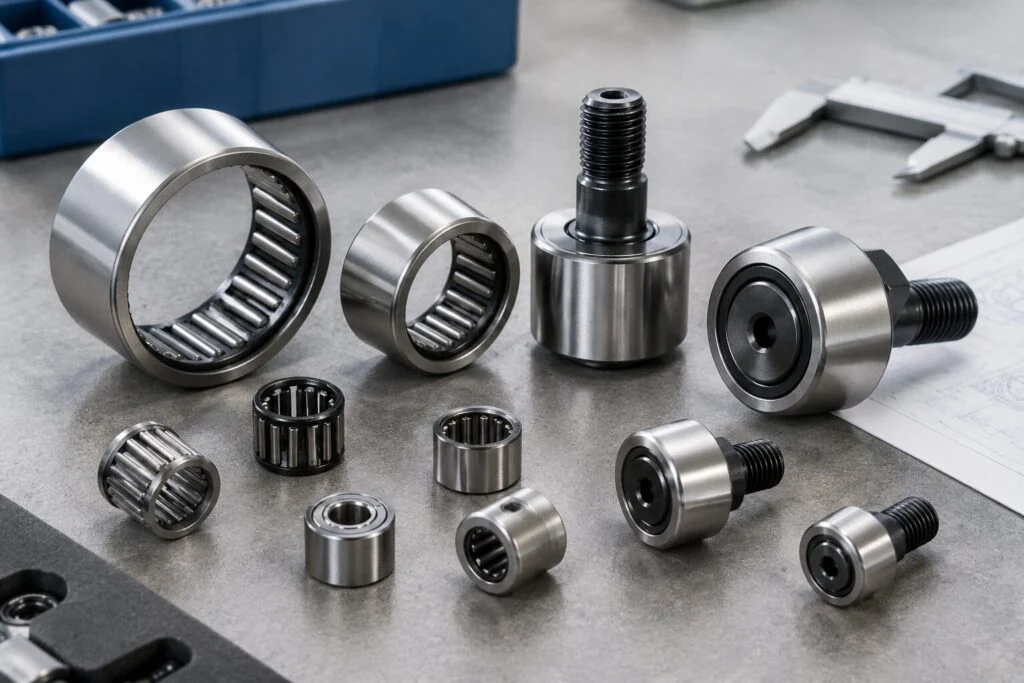
INA Linear Guides for Semiconductor Stages Wholesale Supplier
Highest mechanical precision does not guarantee cleanroom success.
Deploying INA linear guides semiconductor stages requires strict adherence to ISO cleanroom standards, specialized low-outgassing lubrication, and precise tolerance matching to prevent particle contamination. Standard industrial bearings, regardless of their mechanical accuracy, will fail in wafer fabrication environments due to uncontrolled particulate emission and volatile organic compound release.
I learned this the hard way while stationed in Vietnam, moving between electronics factories in Bac Ninh and packaging lines in Hai Phong. Early in my career, I supplied a batch of standard industrial-grade linear guides to a local semiconductor facility without fully accounting for the specific cleanroom operating conditions. The rails were mechanically sound, but within half a month, particle counts exceeded limits, causing wafer yield to drop noticeably. The client nearly demanded full compensation. That incident shifted my focus entirely to the intersection of precision mechanics and environmental compatibility. Selecting INA linear guides semiconductor stages is not about matching a part number; it is about verifying the entire system’s behavior under vacuum or classified air conditions. A slight mismatch in grease viscosity or seal material can halt an entire production line.
Understanding why standard components fail is the first step toward reliable motion control in sensitive manufacturing.
Why Standard INA Guides Fail in Semiconductor Stages?
Standard industrial guides emit particles and outgas, ruining wafer yield.
In high-precision semiconductor manufacturing, the primary enemy is not mechanical wear but contamination. Standard industrial linear guides are designed for durability in harsh environments like mining or construction, where dust and moisture are present. However, these same design features become liabilities in a cleanroom. The seals on standard guides often use materials that shed microscopic particles as they flex during motion. Furthermore, the internal lubricants are formulated for high load capacity and long life, not for low volatility.
When these standard components are installed in INA linear guides semiconductor stages, two critical failures occur. First, the mechanical action of the ball recirculation generates particulate matter from the seal lips and the grease itself. Second, conventional greases undergo outgassing, releasing volatile compounds into the chamber. In lithography or etching processes, these contaminants settle on wafers, causing defects that reduce yield significantly. [NEED_CITE: impact of particulate contamination on semiconductor yield rates]
A European equipment builder once reported that switching from standard industrial bearings to cleanroom-certified units reduced their customer’s maintenance cycle extension needs dramatically. The difference was not in the steel quality but in the surface treatment and lubricant formulation. For buyers sourcing INA linear guides semiconductor stages, it is crucial to distinguish between general-purpose precision and cleanroom-ready specifications. The latter involves specialized cleaning processes, particle-free packaging, and lubricants that meet strict mass loss criteria.
The cost of failure in semiconductor production far outweighs the premium for certified components.
How to Match INA Guide Precision for Cleanroom Stages?
Selecting the right tolerance class and preload for nanometer stability.
Precision in semiconductor stages is not just about positional accuracy; it is about thermal stability and repeatability. While higher precision classes like P4 or P2 offer tighter dimensional tolerances, they are not always the optimal choice for every axis in a semiconductor tool. Excessive preload, often used to achieve high rigidity, can generate heat through friction. This thermal drift causes nanometer-level alignment errors in lithography equipment, leading to positioning deviation over time.
When configuring INA linear guides semiconductor stages, engineers must balance mechanical precision with thermal management. A common mistake is specifying the highest possible precision grade without considering the heat dissipation capabilities of the stage. In many cases, a P5 class guide with optimized preload provides better overall system stability than a P4 class guide running hot. [NEED_CITE: thermal drift effects on lithography alignment accuracy]
| Parameter | Standard Industrial Selection | Cleanroom Semiconductor Selection |
|---|---|---|
| Precision Class | Focus on highest mechanical tolerance (P4/P2) | Balanced tolerance (P5/P4) with thermal stability |
| Preload Level | High for maximum rigidity | Optimized to minimize friction heat |
| Material | Standard bearing steel | Corrosion-resistant or coated options if required |
| Verification | Dimensional check only | Thermal drift rate and particle count testing |
A case from a Southeast Asian assembly plant illustrated this point. They experienced recurring alignment issues in their bonding machines despite using high-precision guides. Upon analysis, the issue was traced to thermal expansion caused by excessive preload. Adjusting the preload specification and selecting guides with better heat dissipation characteristics resolved the drift. For distributors and OEMs sourcing INA linear guides semiconductor stages, providing technical support on preload selection is as important as supplying the correct part number.
Precision must be defined by system performance, not just catalog specifications.
What Lubrication Prevents Outgassing in Semiconductor Motion?
Mandatory use of low-outgassing, cleanroom-certified greases.
Lubrication is the most frequent source of contamination in vacuum and cleanroom applications. Standard "long-life" industrial greases are formulated to resist washout and handle heavy loads, but they contain base oils and additives that volatilize under low pressure or elevated temperatures. This outgassing deposits films on optical lenses and sensors, degrading performance. In semiconductor stages, the lubricant must have minimal mass loss and negligible vapor pressure.
Specialized cleanroom lubricants for INA linear guides semiconductor stages are engineered to meet strict outgassing standards. These greases often have shorter re-lubrication intervals compared to industrial counterparts because they lack the heavy tackifiers that extend service life in dirty environments. This is a counter-intuitive trade-off: achieving cleanliness requires more frequent maintenance or sealed-for-life designs with verified lubricant volumes. [NEED_CITE: ASTM E595 outgassing test standards for space and vacuum applications]
A Middle East research facility faced repeated sensor fouling in their vacuum deposition chambers. The root cause was identified as outgassing from the linear guide grease. Switching to a perfluoropolyether-based lubricant, which is compatible with INA linear guides semiconductor stages, eliminated the film buildup. However, the maintenance team had to adjust their schedule to account for the different wear characteristics of the new lubricant.
| Lubricant Type | Outgassing Performance | Service Life | Cleanroom Suitability |
|---|---|---|---|
| Standard Industrial Grease | High mass loss | Extended | None |
| Synthetic Cleanroom Grease | Low mass loss | Moderate | Certified for ISO Class 1-5 |
| Perfluoropolyether (PFPE) | Negligible mass loss | Shorter/Moderate | Suitable for Vacuum/UHV |
Sourcing the correct lubricant is as critical as selecting the bearing itself. Suppliers must provide certificates of analysis confirming the lubricant’s compliance with relevant cleanroom standards.
Cleanliness is maintained by chemistry as much as by mechanics.
How to Verify Genuine Cleanroom-Ready INA Guides?
Checking traceability, specific suffix codes, and lubrication certificates.
Counterfeit or mislabeled bearings pose a significant risk in high-value semiconductor manufacturing. A genuine INA linear guides semiconductor stages component comes with full traceability documentation, including material certificates and lubrication batch numbers. Verifying authenticity goes beyond checking the logo on the packaging. It involves validating specific suffix codes that indicate cleanroom preparation, such as special cleaning processes or sealing configurations.
Buyers should request proof of origin and technical datasheets that explicitly state the cleanroom class compatibility. Genuine products from authorized channels will have consistent batch-to-batch quality, ensuring that the particle emission levels remain within specified limits. [NEED_CITE: SEMI standards for semiconductor equipment materials]
A US buyer once received a shipment of guides that looked identical to genuine parts but lacked the proper surface finish certification. When installed, these guides generated excessive particles, leading to a mid-six-figure loss in scrapped wafers. The discrepancy was found in the micro-texture of the raceways, which had not undergone the final super-finishing process required for cleanroom use. This highlights the importance of sourcing from suppliers who perform rigorous incoming inspection and verification.
For distributors and MRO operators, establishing a supply chain that guarantees authenticity is essential. This means working with partners who can provide detailed verification documents and technical support for model selection. When procuring INA linear guides semiconductor stages, the paper trail is as important as the physical product.
Trust is built on verifiable documentation, not just brand recognition.
Conclusion
Cleanroom compatibility outweighs raw mechanical precision in semiconductor applications.
Success in semiconductor motion control depends on selecting INA linear guides semiconductor stages that meet strict particle and outgassing standards. Proper lubrication, thermal management, and authentic verification are non-negotiable for maintaining wafer yield. Sourcing from suppliers who understand these nuances ensures reliability and minimizes costly downtime.