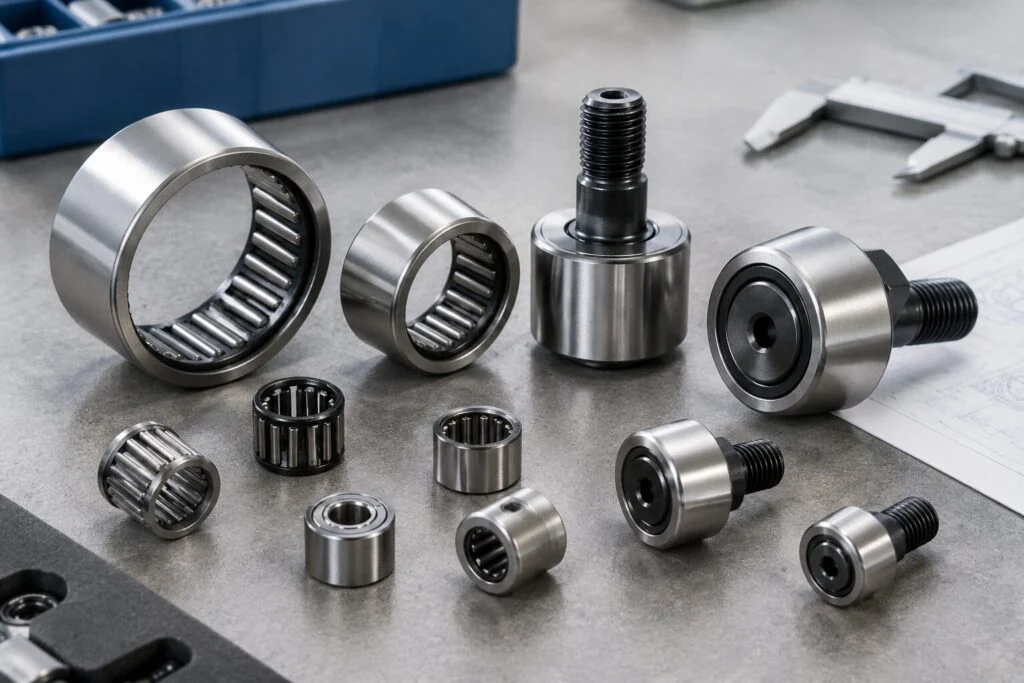
INA Bearings for Gearboxes & Transmissions Wholesale Supplier
Standard catalog dimensions do not guarantee gearbox reliability.
Selecting the correct INA bearings for gearboxes and transmissions requires matching internal clearance groups and lubrication specifications to specific thermal expansion rates and load profiles, rather than relying solely on standard dimensional fits. Premature failures in heavy-duty applications typically stem from mismatched clearance under heat or inadequate cage material selection for high-speed operations, not from manufacturing defects in the bearing itself.
I still remember the metallic crunch that echoed through a testing facility in Hanover years ago. A client had installed what appeared to be perfect cylindrical roller units into a heavy-duty transmission housing. On paper, the dimensions matched the OEM specifications exactly. Yet, within months of high-load operation, the keeping cage shattered. The client arrived with the fragmented remains, expecting a warranty claim for defective goods. The issue was not the bearing quality but the operating environment. The standard clearance had vanished as the housing expanded under thermal load, locking the rollers and causing catastrophic stress on the cage. That incident shifted my focus from simple part number matching to deep technical consultation on工况 conditions. It became clear that selling transmission components is less about inventory volume and more about understanding the physics of failure. [NEED_CITE: common causes of gearbox bearing failure per ISO 15243]
Understanding these nuances is critical for distributors and OEMs who need to ensure long-term equipment uptime. As a global sourcing partner, we see too many orders placed based on outdated catalogs without considering the specific demands of modern heavy machinery. This guide breaks down the technical decisions that separate a reliable transmission from a costly downtime event.
Why Do Standard INA Gearbox Bearings Fail Prematurely?
Thermal expansion and lubrication starvation are the primary drivers of hidden failures in transmission systems.
Most buyers assume that if the outer diameter and bore size match, the bearing will perform. This is a dangerous oversimplification. In heavy-duty gearboxes, the housing heats up significantly during operation. Steel expands. If the bearing is selected with standard internal clearance, this expansion can eliminate the necessary running gap between rollers and raceways. The result is excessive friction, rapid temperature rise, and eventual seizure.
Another frequent culprit is lubrication mismatch. High-speed gearboxes often generate heat that degrades standard grease before its scheduled replacement interval. When the lubricant film breaks down, metal-to-metal contact occurs, leading to surface distress and spalling. We have observed cases where switching to a higher viscosity oil or a specialized synthetic grease extended service life noticeably, simply by maintaining the elastohydrodynamic film under load. [NEED_CITE: SAE guidelines on lubrication viscosity for gear applications]
For wholesalers supplying MRO clients, it is vital to ask about the operating temperature range and speed. A bearing that works perfectly in a low-speed agricultural gearbox may fail quickly in a high-speed industrial reducer. Our technical team routinely reviews these parameters to prevent such mismatches, ensuring that the supplied INA bearings for gearboxes and transmissions are suited for the actual working environment, not just the drawing board.
INA Cylindrical vs. Tapered Roller Bearings: Which Fits Your Transmission?
Cylindrical roller bearings excel at handling high radial loads, while tapered roller bearings manage combined axial and radial shocks.
Choosing between these two types depends on the force vectors present in your transmission design. Cylindrical rollers offer high radial load capacity and can accommodate high speeds due to their low friction characteristics. They are ideal for intermediate shafts where radial forces dominate. However, they cannot handle significant axial loads unless paired with another bearing type.
Tapered roller bearings, on the other hand, are designed to support combined loads. Their conical geometry allows them to handle thrust forces generated by helical gears or uneven loading conditions. This makes them a preferred choice for output shafts in mining crushers or construction equipment where shock loads are common.
| Feature | Cylindrical Roller Bearings | Tapered Roller Bearings |
|---|---|---|
| Primary Load Capacity | High Radial | Combined Radial and Axial |
| Speed Capability | High | Moderate to High |
| Alignment Sensitivity | Low (self-aligning variants available) | Requires precise mounting |
| Typical Application | Intermediate shafts, high-speed stages | Output shafts, heavy-shock environments |
| Installation Complexity | Moderate | High (requires preload adjustment) |
[NEED_CITE: mechanical engineering principles for rolling element bearing selection]
A European wind farm operator once faced repeated failures on their gearbox input shafts. They were using cylindrical bearings exclusively. After analysis, we identified that unexpected axial thrust from wind gusts was overloading the non-axial-capable setup. Switching to a paired arrangement with tapered rollers on the high-load end resolved the issue. This highlights the importance of analyzing load directions, not just magnitude.
When sourcing INA bearings for gearboxes and transmissions, ensure you understand the load profile. Our inventory includes both series, allowing us to provide mixed-batch solutions that optimize performance across different shaft positions within a single gearbox assembly.
The Critical Role of Internal Clearance in High-Temp Gearboxes
Standard clearance bearings seize under heat; C3 and C4 clearance groups are mandatory for heavy-duty cycles.
Internal clearance is the space between the rolling elements and the raceways when the bearing is unloaded. In a cold state, standard clearance (C0) might seem sufficient. But as the gearbox operates, the inner ring heats up faster than the outer ring, and the housing expands. This thermal growth reduces the effective clearance. If it drops to zero or becomes negative, the bearing locks up.
For applications involving significant temperature fluctuations or high ambient heat, selecting a bearing with greater initial clearance is essential. C3 clearance offers a moderate increase, suitable for many industrial motors and general gearboxes. C4 clearance provides even more space, designed for severe thermal conditions such as those found in steel mill reducers or large mining transmissions.
We frequently advise clients against defaulting to standard clearance for any heavy-industry application. A Middle East cement plant experienced repeated overheating issues until we switched their supply to C3-clearance INA units. The slight increase in initial gap accommodated the thermal expansion, preventing the friction-induced heat spiral. [NEED_CITE: ISO standards for bearing internal clearance classes]
It is crucial to note that excessive clearance can lead to vibration and noise in low-load scenarios. Therefore, the selection must balance thermal needs with operational stability. Our team helps buyers map their operating temperature ranges to the appropriate clearance group, ensuring that the INA bearings for gearboxes and transmissions they procure are optimized for longevity.
Lubrication & Cage Material: Matching the Operating Environment
Brass versus polyamide cages and oil-mist versus grease dictate extreme load survival.
The cage holds the rolling elements in place and guides them. In high-speed or high-vibration environments, the cage material is as critical as the steel quality. Polyamide (nylon) cages are lightweight and offer good emergency running properties if lubrication fails briefly. However, they have temperature limits and can degrade in certain chemical environments. Brass cages are more robust, handling higher temperatures and heavier shocks, making them preferable for heavy-duty mining or steel applications.
Lubrication method also plays a pivotal role. Grease is convenient for sealed units but has speed and temperature limits. Oil splash or mist lubrication is superior for high-speed gearboxes as it dissipates heat more effectively and ensures continuous replenishment of the lubricant film. Using grease in a high-DN-value application can lead to churning losses and overheating.
| Factor | Polyamide Cage | Brass Cage |
|---|---|---|
| Weight | Light | Heavy |
| Temperature Resistance | Moderate | High |
| Shock Load Handling | Good | Excellent |
| Chemical Resistance | Variable | Robust |
| Best For | General industrial, moderate speed | Heavy-duty, high-temp, high-shock |
[NEED_CITE: metallurgical failure analysis reports on bearing cage materials]
A case from a South American mining operation illustrated this well. Their transmission cages were failing prematurely due to high shock loads. Switching from polyamide to brass cages, combined with a switch to synthetic oil lubrication, doubled the component lifespan. The brass provided the structural integrity needed to withstand the impact, while the oil kept the system cool.
When you order INA bearings for gearboxes and transmissions from us, we verify the cage material and lubrication compatibility against your specified operating conditions. This attention to detail prevents the kind of premature failures that disrupt production schedules.
Conclusion
Reliability in transmission systems comes from precise technical matching, not just brand recognition.
Selecting the right components involves understanding thermal dynamics, load vectors, and material limitations. By focusing on internal clearance, cage composition, and lubrication methods, buyers can avoid the common pitfalls that lead to early gearbox failure. As a dedicated supplier, we prioritize this technical alignment to ensure that every INA bearings for gearboxes and transmissions unit we deliver contributes to stable, long-term operational success.