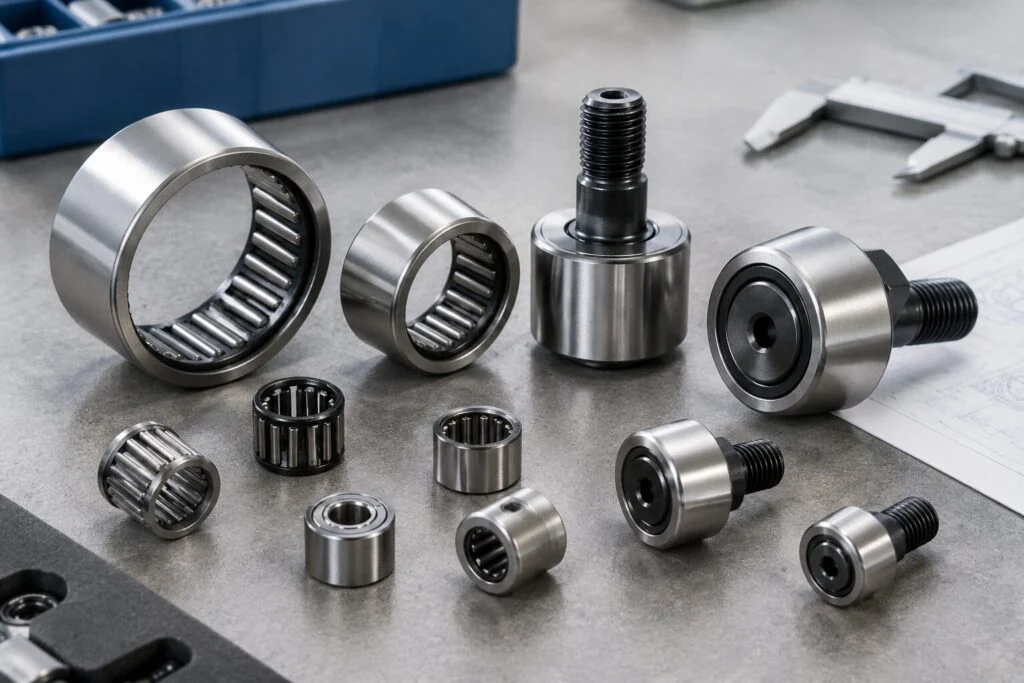
INA Bearing Prices: Wholesale Supplier for Bulk Orders
The cheapest unit price often triples your total ownership cost.
INA product prices are driven by precision class, material purity, and original traceability rather than arbitrary markups. True cost optimization requires balancing genuine bearing costs against lifecycle reliability and leveraging mixed-batch logistics to lower landed expenses.
When I was handling reducer assembly after-sales in Ningbo, I watched too many buyers chase the lowest quote for channel-unknown INA bearings. They saved pennies on the purchase order but lost thousands when the spindle seized within months. The heat buildup locked the shaft, halting the entire production line. Calculating the downtime loss and emergency labor, the total cost far exceeded the initial savings. That reality shifted my focus from unit price hunting to verifying supply chain integrity. Now, when I analyze sourcing strategies, I look at the full lifecycle impact. [NEED_CITE: relationship between bearing precision and equipment lifespan]
Understanding these dynamics helps distributors and OEMs negotiate effectively. It moves the conversation from simple discounting to value-based procurement. This guide breaks down the real drivers behind INA product prices and shows how to optimize your sourcing without compromising on quality.
What Exactly Drives INA Product Prices?
Cost is tied to material grade, precision, and original traceability, not arbitrary markups.
Many buyers assume that brand prestige alone inflates INA product prices. In reality, the manufacturing process for high-precision bearings involves stringent controls that directly impact cost. The primary drivers are the steel quality, the machining precision, and the verification systems that ensure every batch meets ISO standards.
Material purity is a major factor. Genuine INA bearings use vacuum-degassed steel with controlled inclusion levels. This reduces the risk of early fatigue failure under heavy loads. Lower-grade alternatives may use standard commercial steel, which contains more impurities. These impurities act as stress concentrators, leading to premature spalling. [NEED_CITE: impact of steel cleanliness on bearing fatigue life]
Precision class also dictates pricing. Bearings are graded from P0 (normal) to P5 (high precision). Each step up in precision requires tighter tolerances for dimensions and running accuracy. Achieving P5 or P4 levels demands advanced grinding and super-finishing processes. This increases production time and rejection rates, which is reflected in the final INA product prices.
| Precision Class | Tolerance Level | Typical Application | Cost Driver |
|---|---|---|---|
| P0 (Normal) | Standard | General machinery, agricultural equipment | Base manufacturing cost |
| P6 (Class 6) | Reduced | Electric motors, pumps, gearboxes | Enhanced grinding precision |
| P5 (Class 5) | High | Machine tool spindles, high-speed applications | Super-finishing, strict inspection |
| P4 (Class 4) | Very High | Precision instruments, high-speed spindles | Micron-level control, low noise |
Traceability adds another layer of value. Genuine products come with batch-specific documentation that links the bearing back to the raw material lot. This ensures consistency across large orders. Counterfeit or gray-market items lack this link, making it impossible to verify their origin or quality history. When you compare INA product prices, you are paying for this assurance of consistency.
For OEMs, this consistency is critical. A variation in hardness or geometry can cause widespread issues in assembled units. Therefore, the premium for genuine traceability is an insurance policy against batch failures.
Genuine vs. Channel-Unknown: The Hidden Cost Matrix?
Counterfeits save pennies upfront but multiply lifecycle failure rates.
The market is flooded with bearings that look identical to genuine INA products but sell at a fraction of the cost. These channel-unknown items often bypass quality controls, using inferior cages, seals, or lubricants. While the initial purchase price is lower, the hidden costs emerge quickly during operation.
A common scenario involves a mining equipment operator who switched to a cheaper alternative for conveyor rollers. The bearings failed prematurely due to poor seal integrity, allowing dust ingress. The resulting downtime required emergency repairs and replacement of damaged shafts. The total cost of ownership skyrocketed compared to sticking with genuine parts. [NEED_CITE: case studies on counterfeit bearing failure modes]
To visualize this, consider the risk matrix below. It contrasts genuine INA products with channel-unknown alternatives across key performance indicators.
| Feature | Genuine INA | Channel-Unknown | Risk Level |
|---|---|---|---|
| Material Traceability | Full batch certification | None or forged documents | High |
| Dimensional Accuracy | ISO compliant (P0-P5) | Inconsistent, often out of spec | High |
| Seal Quality | Original compound, tested | Generic rubber, prone to degradation | Medium |
| Lubrication | Correct type and quantity | Unknown, potentially incompatible | High |
| Lifecycle Reliability | Predictable, long service life | Unpredictable, early failure likely | Critical |
The "savings" from buying unknown channels are illusory. When a bearing fails in a critical application, the cost of unplanned downtime dwarfs the price difference. For MRO buyers, this means keeping genuine stock is cheaper than dealing with frequent breakdowns.
Verifying authenticity is essential. Genuine bearings have precise laser markings, smooth finishing, and consistent packaging. Counterfeits often show rough edges, misspelled labels, or inconsistent font sizes. Always demand original mill certificates and batch tracking numbers before bulk payment. This step prevents counterfeit infiltration and protects your operational continuity.
How to Optimize Sourcing Costs via Mixed Batches?
Consolidating multi-brand, multi-size orders reduces freight and lowers average unit costs.
Negotiating single-item discounts is a traditional approach, but it often misses larger savings opportunities. Modern logistics allow for mixed-batch consolidation, where buyers combine different brands and sizes into one shipment. This strategy significantly lowers landed costs by optimizing container space and reducing per-unit freight charges.
For regional distributors, ordering full containers of a single SKU is rarely efficient. Demand varies across models, leading to overstock of slow-moving items and stockouts of fast movers. By mixing SKUs, you align inventory with actual market demand. This flexibility improves cash flow and reduces warehousing costs. [NEED_CITE: logistics efficiency in mixed-SKU container loading]
Consider a distributor in Southeast Asia who needed various spherical roller bearings and deep-groove ball bearings. Instead of placing separate small orders with high air freight costs, they consolidated a mixed container. The result was a noticeable drop in average unit cost, even without deep discounts on individual items. The savings came from optimized logistics and reduced handling fees.
| Sourcing Strategy | Freight Efficiency | Inventory Flexibility | Admin Overhead |
|---|---|---|---|
| Single-Item Bulk | Low (partial containers) | Low (rigid volumes) | High (multiple POs) |
| Mixed-Batch Consolidation | High (full container utilization) | High (tailored mix) | Low (single PO) |
This approach also simplifies customs clearance. One consolidated shipment means one set of documents and one inspection process. It reduces the administrative burden and speeds up time-to-market. For urgent MRO requirements, having a supplier who can provide mixed-brand solutions ensures you get the right part quickly, minimizing downtime.
When evaluating INA product prices, look beyond the unit cost. Ask your supplier about mixed-batch options. A flexible partner can help you build a container load that matches your exact needs, turning logistics into a competitive advantage.
How to Verify Traceability Before Bulk Payment?
Demanding original mill certificates and batch tracking prevents counterfeit infiltration.
Trust but verify is the golden rule in bearing procurement. With sophisticated counterfeits entering the market, visual inspection is no longer enough. You need documentary evidence that links the physical product to the manufacturer’s records. This is where traceability becomes a critical checkpoint.
Start by requesting the original mill certificate for the steel used in the bearings. This document specifies the chemical composition and heat treatment details. Compare it with the batch number on the bearing box. If the supplier cannot provide this, or if the numbers do not match, it is a red flag. [NEED_CITE: importance of material certificates in quality assurance]
Next, check the batch tracking information. Genuine INA products have unique codes that can be verified through official channels. These codes reveal the production date, factory location, and quality inspection results. A reliable supplier will have access to this data and share it transparently.
| Verification Step | Document Required | What to Check |
|---|---|---|
| Material Origin | Mill Certificate | Steel grade, heat number, chemical analysis |
| Production Batch | Factory Inspection Report | Date, shift, quality parameters |
| Authenticity | Official Traceability Code | Match code with manufacturer database |
| Logistics | Packing List & Invoice | Consistency in quantities and descriptions |
A European wind farm operator once avoided a major issue by insisting on these checks. They received a shipment that looked correct, but the batch codes did not align with the manufacturer’s records. Further investigation revealed the goods were diverted from a different market with different specifications. By catching this early, they prevented potential turbine failures.
Integrating these checks into your procurement process adds a layer of security. It ensures that every bearing you buy meets the expected standards. When discussing INA product prices with suppliers, ask about their traceability protocols. A partner who prioritizes documentation is a partner who prioritizes your success.
Conclusion
True savings come from reliability, not just low unit prices.
INA product prices reflect the value of precision, material quality, and traceable origins. By understanding these drivers, buyers can move beyond superficial cost comparisons. Focus on lifecycle reliability and leverage mixed-batch logistics to optimize total ownership costs. Verify every shipment with rigorous traceability checks to protect your operations from counterfeit risks. This strategic approach ensures long-term efficiency and peace of mind.