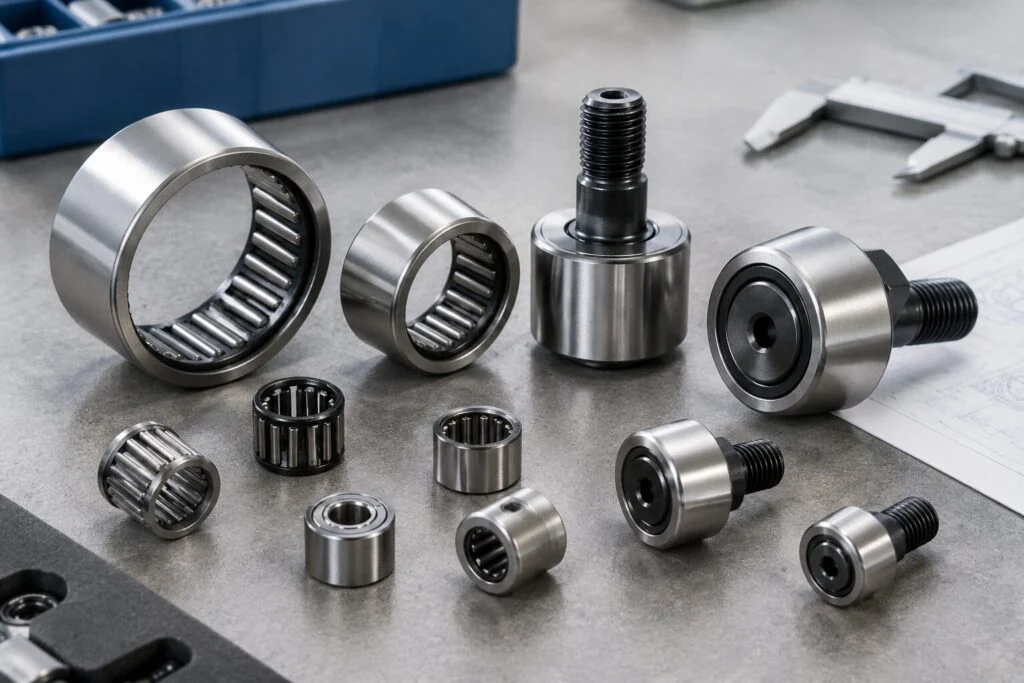
Genuine INA Bearings for Robots Wholesale Supplier
Cheaper robot bearings often destroy expensive servo motors.
Selecting the right genuine INA robot joint bearings requires strict verification of precision classes and authentic sourcing, as counterfeit or mis-specified bearings cause rapid joint failure and production downtime. The core issue is not just price, but the material purity and geometric accuracy required to handle high cyclic loads in automation.
I still remember the humidity in Lagos. A sorting line had stopped cold. The mechanical arm was jerking, missing picks by millimeters. The maintenance team blamed the controller. I asked to see the joint bearings. They were branded INA, but the packaging looked off. We pulled one out. The raceway was pitted with micro-craters, and the cage had fractured into shards. It was a fake. The friction from that poor-quality steel had overheated the reducer, warping internal gears. Replacing the bearing was cheap; replacing the entire drive unit cost ten times more. That incident changed how I view supply chains. In robotics, a bearing is not just a component; it is the foundation of precision. [NEED_CITE: impact of bearing friction on servo motor lifespan]
When you source INA bearings for robots, you are buying tolerance. You are buying the assurance that the inner and outer rings will remain concentric under millions of cycles. If the source is dubious, the risk is not just a replacement part order; it is unplanned downtime that halts your entire production line.
Why Do Robot Joints Fail Prematurely with Non-Genuine Bearings?
Counterfeit bearings lack the material purity required for high-cycle automation.
In a standard industrial fan, a slight imperfection in steel might mean noise. In a six-axis robotic arm, it means catastrophic failure. Robot joints operate under complex load patterns: radial, axial, and moment loads shift constantly as the arm moves. Genuine INA products use high-purity steel with controlled inclusion levels to resist fatigue. Counterfeit versions often use recycled or lower-grade steel that contains hidden impurities.
Under high cyclic loads, these impurities become stress concentrators. Micro-pitting begins on the raceway. This roughness increases friction. Increased friction generates heat. Heat expands the metal, altering the internal clearance. Suddenly, the bearing seizes. I have seen this pattern repeat in facilities across Southeast Asia and the Middle East. The initial symptom is always a slight increase in motor current draw, often ignored until the joint locks up.
The cage is another weak point. In genuine INA needle roller bearings for automation, the cage is designed to guide rollers precisely, even at high speeds. Fakes often use brittle plastic or poorly machined metal cages. When the robot accelerates, the cage cannot handle the inertial forces. It shatters. The loose rollers then jam between the rings, scoring the raceways and destroying the housing.
| Failure Mode | Genuine INA Bearing | Counterfeit/Low-Quality Bearing |
|---|---|---|
| Steel Purity | Controlled inclusion density | Uncontrolled, high impurity risk |
| Cage Material | Robust, engineered polymer or steel | Brittle, prone to fracture |
| Raceway Finish | Micron-level precision, smooth | Visible tool marks, rough |
| Fatigue Life | Substantially extended | Vulnerable to early spalling |
| Traceability | Full batch-level documentation | None or self-reported only |
[NEED_CITE: ISO 15243 classification of bearing failure modes]
A European automation integrator once told me they switched to verified sources after losing three arms in a month. The root cause was not design error, but bad batches of bearings that looked identical to the eye but failed under load. The cost of the fake bearings was negligible compared to the loss of production time.
Which INA Bearing Types Fit Specific Robot Joint Designs?
Not all INA bearings are interchangeable; geometry dictates performance.
Choosing the wrong type leads to premature wear, even if the brand is genuine. Robot designers must match the bearing structure to the joint’s kinematic requirements. There are three primary categories used in modern robotics, each serving a distinct function.
Thin-section bearings are critical for lightweight arms. These INA thin section bearings for robotic arms offer a high load capacity relative to their cross-sectional height. This allows designers to reduce the overall weight of the arm, improving acceleration and energy efficiency. However, they are sensitive to mounting errors. If the housing is not perfectly round, the thin rings deform, causing uneven load distribution.
Crossed roller bearings are the standard for heavy payload joints, such as the base or shoulder of a large industrial robot. They can handle combined radial, axial, and moment loads simultaneously. The crossed arrangement of the rollers provides high rigidity, which is essential for maintaining position accuracy when the arm is extended with a heavy tool.
Needle roller bearings are used where space is at a premium. In compact joints or wrist assemblies, INA needle roller bearings for automation provide high radial load capacity in a minimal envelope. They are often used in conjunction with other bearing types to support specific load paths without adding bulk.
| Bearing Type | Primary Load Capacity | Typical Robot Application | Sensitivity to Mounting |
|---|---|---|---|
| Thin-Section | Radial and Axial | Lightweight arms, wrists | High |
| Crossed Roller | Combined (Radial/Axial/Moment) | Base, Shoulder, Elbow | Medium |
| Needle Roller | Radial | Compact joints, gearboxes | Low |
[NEED_CITE: Schaeffler technical catalog load rating guidelines]
I recall a project in Brazil where a builder tried to use standard deep groove ball bearings in a wrist joint to save cost. The result was excessive play. The end-effector wobbled, making precise assembly impossible. They had to redesign the housing to accept the correct thin-section bearings. The delay cost them weeks.
How to Verify the Authenticity of INA Bearings Before Installation?
Visual inspection is not enough; traceability is mandatory.
Counterfeiters have become sophisticated. Packaging can be replicated. Labels can be printed with high resolution. Relying on the look of the box is a recipe for disaster. Verification must go deeper. As a INA bearing supplier for robotics, I insist on checking the physical markers and documentation before any part enters inventory.
First, check the laser marking. Genuine INA bearings have precise, clean laser etching on the ring. The font is consistent, and the depth is uniform. Fakes often have markings that are too deep, too shallow, or slightly blurred. Second, inspect the packaging quality. Original boxes use specific cardboard grades and printing techniques. The holographic seals, if present, should change color when tilted. But the most critical step is the traceability code.
Every genuine bearing has a unique code that links it to the production batch. You must request the official mill certificate or test report from your supplier. This document confirms the material composition and heat treatment data. If a supplier cannot provide this, walk away. No exceptions.
We consolidate various INA bearings for robots into single shipments for our clients, ensuring every item comes with full documentation. This eliminates the risk of mixed batches where a few fakes slip in among genuine parts. A client in Turkey once received a container where 10% of the bearings were suspect. Because we provided full traceability for our portion, they could isolate the bad supplier and return the faulty goods without halting their line.
| Verification Step | What to Check | Red Flag |
|---|---|---|
| Laser Marking | Font consistency, depth, clarity | Blurred, uneven, or missing characters |
| Packaging | Cardboard quality, print resolution, seals | Flimsy box, low-res printing, missing seals |
| Traceability Code | Unique batch code on bearing and box | Code missing, mismatched, or unverifiable |
| Documentation | Mill certificate, test report | Supplier refuses to provide or provides generic docs |
[NEED_CITE: Schaeffler anti-counterfeit verification guidelines]
What Precision and Clearance Classes Are Required for Automation?
Standard clearance is often insufficient for high-speed robotic joints.
Most buyers assume all bearings of the same size are identical. They are not. Internal clearance and precision class are critical parameters that dictate performance. In robotics, thermal expansion and torque limits require specific matches.
Precision classes like P5 or P4 define the dimensional and geometrical tolerances of the bearing. Higher precision means less runout and better rotational accuracy. For high-speed joints, P5 is often the minimum requirement. Using a P0 class bearing in a high-precision application will result in vibration and reduced repeatability.
Internal clearance, such as C3 or C4, determines how much room the rolling elements have to move. Robots generate heat during operation. If the clearance is too tight, the bearing will expand and seize. If it is too loose, the robot will lose positional accuracy. Selecting the right clearance requires understanding the operating temperature and load conditions.
I worked with a manufacturer in Vietnam who was experiencing premature failures in their palletizing robots. They were using standard C3 clearance bearings. The joints were running hot, causing the clearance to close up. We switched them to C4 clearance bearings with P5 precision. The temperature dropped, and the lifespan increased significantly. The key was matching the specification to the thermal reality of the application.
| Parameter | Standard Industrial Use | Robotics/Automation Use | Reason |
|---|---|---|---|
| Precision Class | P0 or P6 | P5 or P4 | Higher rotational accuracy needed |
| Internal Clearance | C3 | C3 or C4 | Accommodate thermal expansion from high speed |
| Noise Level | Standard | Low Noise | Critical for collaborative robots |
| Lubrication | General Purpose | Specialized Synthetic | Better performance at high speeds/temps |
[NEED_CITE: ISO bearing precision standards and clearance definitions]
Conclusion
Authenticity and precision are non-negotiable in robotics.
Sourcing genuine INA robot joint bearings is not just about buying a part; it is about securing the reliability of your automation. Counterfeit components may save money upfront but cost far more in downtime and equipment damage. Verify every batch, demand traceability, and select the correct precision and clearance for your specific application. Your production line depends on it.