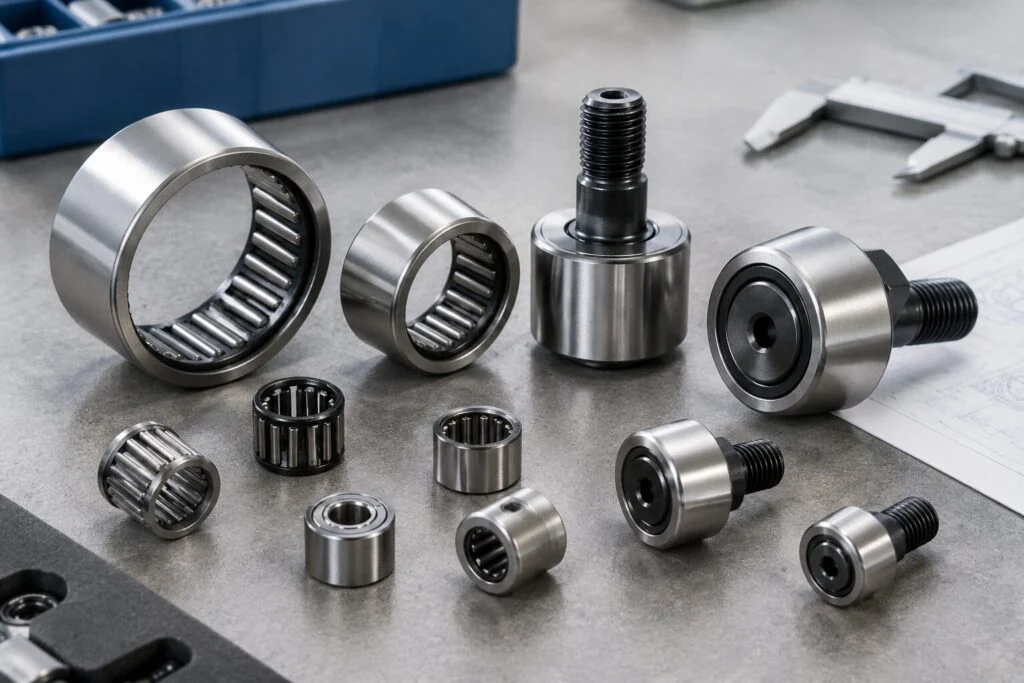
Genuine INA Bearings for Packaging Machinery Wholesale Supplier
Matching the part number is not enough to guarantee performance.
Sourcing genuine INA bearings for packaging machinery requires strict channel traceability and precise clearance selection to prevent high-speed failures in clean-environment applications.
The first time I shipped a batch of needle roller bearings to a beverage plant in Jeddah, I thought the job was done when the bill of lading matched the purchase order. The client had ordered specific components for their high-speed filling line. To meet a tight budget, we sourced from a secondary market trader who promised "original quality." The parts looked correct. The packaging was intact. But when the client installed them, the spindle seized within hours. The entire production line stopped for two days. The loss was not just in the cost of the bearings, but in the spoiled product and the missed delivery windows. That incident changed how I view supply chains. It taught me that in the packaging industry, the channel is as critical as the component itself. [NEED_CITE: impact of counterfeit bearings on industrial downtime]
For buyers managing MRO budgets or OEM production lines, the risk of refurbished or counterfeit parts is real. This guide breaks down how to verify authenticity, select the right specifications for high-speed operations, and avoid the hidden costs of non-genuine components.
Why Do Packaging Machines Demand Specific INA Bearings?
High-speed filling and sealing operations generate unique thermal and load conditions that standard industrial bearings cannot withstand.
Packaging machinery operates in a distinct environment. Unlike heavy mining equipment that deals with shock loads, packaging lines prioritize speed, precision, and hygiene. A typical filling machine might run at thousands of cycles per hour. In these conditions, even minor friction increases can lead to significant heat buildup. [NEED_CITE: thermal expansion effects in high-speed rotating components]
INA bearings are often specified for these applications because of their design in needle and cylindrical roller configurations. These designs offer high load capacity in a compact space, which is essential for the tight confines of packaging heads. However, the demand goes beyond just the brand name. The internal geometry must match the operational speed.
Consider a food packaging OEM I worked with recently. They were experiencing premature failure in their capping stations. The issue was not the load, but the speed. The original specification called for a standard clearance. At high rotational speeds, the inner ring expands due to heat. If the initial clearance is too tight, this expansion eliminates the running gap, leading to metal-to-metal contact and eventual seizure. By switching to traceable INA needle rollers with optimized clearance, they saw a substantial extension in service life. [NEED_CITE: relationship between bearing clearance and operating temperature]
This is why generic replacements often fail. They may fit physically, but they lack the precise internal tolerances required for stable high-speed operation. The stability of the packaging process depends on the bearing maintaining its geometric integrity under thermal stress.
How to Compare INA Bearing Specifications for Packaging Lines?
A matrix comparison of load capacity, speed limits, and sealing types ensures optimal selection for specific packaging tasks.
When evaluating options, buyers often look only at the outer dimensions. This is a mistake. For packaging machinery, three key parameters define suitability: dynamic load rating, limiting speed, and sealing effectiveness.
| Specification Factor | Standard Industrial Grade | High-Speed Packaging Grade |
|---|---|---|
| Clearance Class | Standard (C0/CN) | Optimized (C3/C4) for thermal expansion |
| Sealing Type | Basic Rubber Contact | Low-Friction Non-Contact or Hybrid |
| Lubrication | General Purpose Grease | Food-Grade or High-Speed Synthetic |
| Precision Level | Normal (P0) | Higher (P5/P6) for reduced vibration |
Note: Clearance classes such as C3 and C4 are standard ISO designations indicating greater internal radial clearance than normal.
The table above highlights the differences. In a high-speed filler, a standard clearance bearing may overheat. A C3 or C4 clearance allows for thermal growth without preloading the rolling elements. Similarly, sealing is critical. In food packaging, lubricants must not contaminate the product. Therefore, bearings often require seals that prevent grease leakage while keeping contaminants out. [NEED_CITE: ISO standards for bearing sealing effectiveness]
I once helped a distributor in Southeast Asia consolidate an order for a mixed-brand packaging line. They were using various brands for different sections of the machine. By standardizing on genuine INA components with verified C3 clearance for the high-speed sections, they reduced the variety of spare parts they needed to stock. This simplification led to faster maintenance response times.
What Are the Risks of Non-Genuine INA Bearings?
Refurbished parts cause catastrophic spindle failures and massive production downtime.
The market for branded bearings is flooded with refurbished items sold as new. These bearings may have been cleaned and repackaged, but their internal raceways have already experienced fatigue. In a low-speed application, this might not be immediately apparent. In a high-speed packaging line, it is a ticking time bomb.
A Middle East beverage plant learned this the hard way. As mentioned in my introduction, the seized spindle resulted in a two-day shutdown. The cost of the replacement bearings was negligible compared to the lost production. The root cause was a lack of traceability. The supplier could not provide original mill certificates.
Non-genuine bearings also pose a hygiene risk. In food and pharmaceutical packaging, materials must meet strict safety standards. Counterfeit or refurbished bearings may use inferior steel or non-compliant lubricants. If a seal fails, these substances can contaminate the product line, leading to recalls and regulatory penalties. [NEED_CITE: regulatory requirements for materials in food processing machinery]
Another risk is dimensional inconsistency. Genuine INA bearings adhere to strict ISO 15 dimensional tolerances. Refurbished or fake parts may vary slightly in outer diameter or width. This variation can cause misalignment in the housing, leading to uneven load distribution and premature wear of adjacent components.
How to Verify Authenticity and Traceability?
Demand original mill certificates and anti-counterfeit QR codes from suppliers.
Verification starts before the goods arrive. It begins with the supplier’s documentation. A reputable source will provide a chain of custody that links the bearing back to the manufacturer. This includes the original invoice from the authorized distributor and the mill certificate that specifies the batch number and material properties.
Many genuine INA bearings now come with anti-counterfeit features. These can include QR codes on the packaging or laser-etched markings on the bearing itself. Scanning these codes should lead to verification pages on the manufacturer’s official system. If a supplier hesitates to provide these details or claims that "paperwork is not available for this batch," it is a major red flag.
I now insist on complete traceability for every order of genuine INA bearings for packaging machinery. For a recent project involving a mixed-brand consolidation for a large MRO distributor, we provided full customs documentation and traceability papers for each brand in the container. This allowed the end-user to verify every item upon receipt.
Technical verification is also possible. Using simple tools, maintenance teams can check the basic dimensions and weight. Genuine bearings have consistent weight due to controlled material density. Significant deviations can indicate inferior steel or hollow components. However, the most reliable method remains documentary traceability.
For buyers sourcing from global markets, working with a supplier who understands these requirements is essential. They should be able to explain the origin of the stock and provide the necessary proofs without delay. This level of transparency is the only way to ensure that the bearings you install are truly genuine.
Conclusion
Authenticity and precise specification are non-negotiable for high-performance packaging machinery.
Sourcing genuine INA bearings for packaging machinery is not just about finding the lowest price. It is about securing the reliability of your production line. By focusing on traceability, selecting the correct clearance class, and verifying documentation, buyers can avoid the costly risks of counterfeit and refurbished parts. The right bearing ensures stability, hygiene, and longevity in demanding high-speed environments.